Can you use the book idea you can already explain?
Follow one idea through the four stops in the wisdom lane, from first explaining it to trying it in a decision.
In short
To use an idea from a book, state what the author claims and explain the reason in your own words.
- Try to bring both back after a gap, before opening the book.
- When you see a place to use the idea, try it and write down what happened and any limits you noticed.
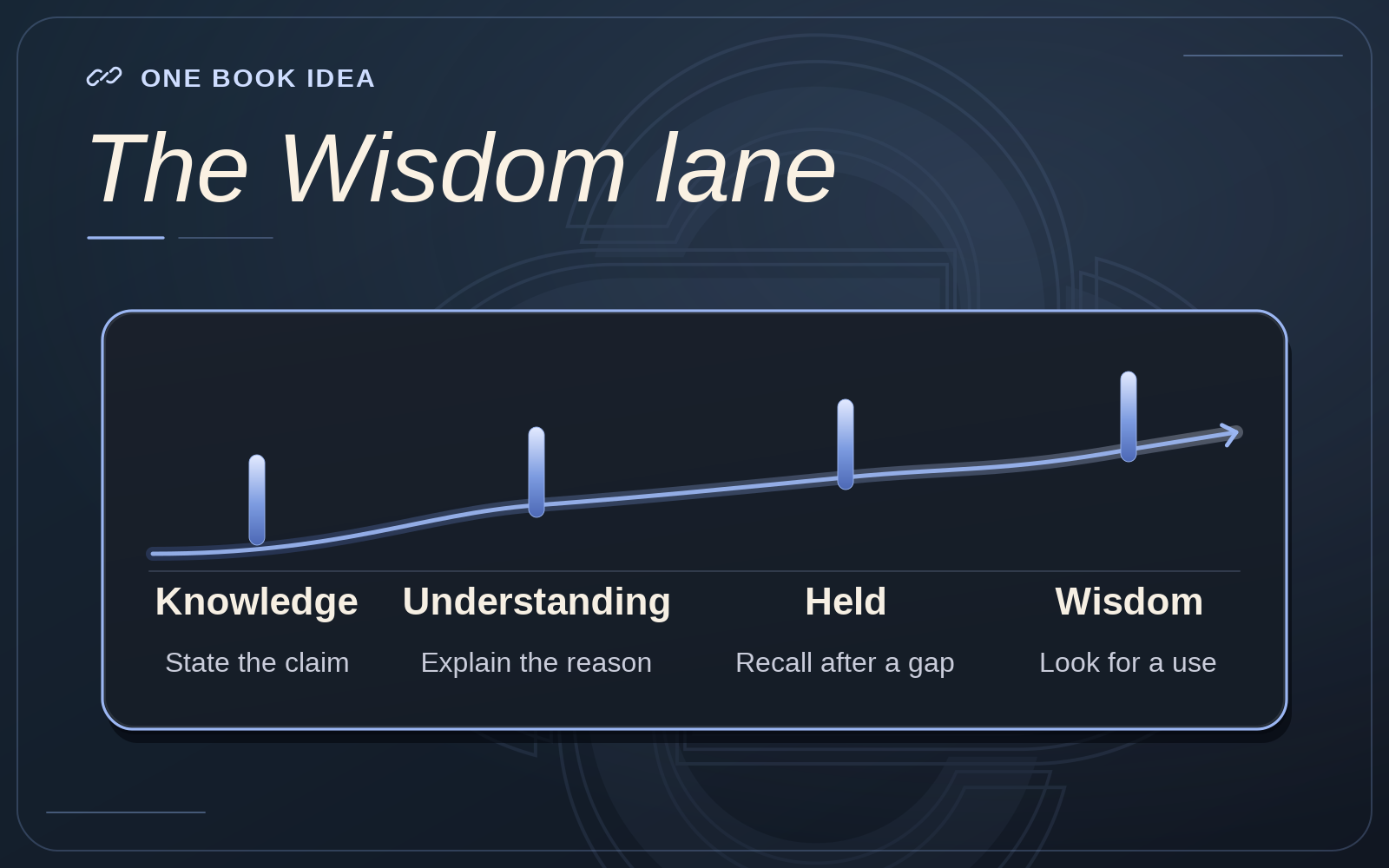
- Pensaya’s wisdom lane shows that work at four stops called knowledge, understanding, held and wisdom.
On this page
What are the four stops in the wisdom lane?
In Pensaya the wisdom lane shows where the book ideas you keep are over time and when they come back. Its four stops are knowledge, understanding, held and wisdom. Your reading group is picking a book. Everyone likes the obvious choice until one person says they cannot get a copy. You remember a line about hearing the other side. Can you find a use for it before the group decides?
In chapter II of On Liberty, John Stuart Mill argues that to understand a position you hold, you have to hear the opposing case as people who believe it would put it. A brisk summary from someone who already agrees with you leaves out the force of the objection. John Stuart Mill, On Liberty (1859), ch. II (opens in a new tab).
| Stop | What to try | What that might look like |
|---|---|---|
| Knowledge | Say what the idea claims. | Understanding your view includes hearing the opposing case from a person who holds it. |
| Understanding | Explain why in your own words. | A sympathetic summary can leave the hardest objection out, so you never check whether your own reasons answer it. |
| Held | Bring the claim and reason back after a gap, before you look. | Ask why Mill wants you to hear an objection from the person making it. Check whether your answer explains what tends to go missing in a summary. |
| Wisdom | Look for a place to use the idea and notice its limits. | In your reading group, ask the person who objected what makes the book hard to get. Availability might call for a different choice or more time. Write down what hearing the objection changed, even if the group picked the same book. |
The reading group is an example of using an idea from Mill’s argument about freedom of thought and discussion. Keep the book’s claim and what happened in your group together on the page.
What if the reason goes missing?
Return to the passage when you can recall the action but have lost the reason. Leave yourself a question about the part you missed. Keep the author’s explanation next to your own and label each one.
Can practising recall help with a new question?
In experiments with short passages, asking people to recall answers helped them handle new inference questions a week later.
In your reading group, the first clue might just be someone saying they cannot get the book.
What can the lane show you about using an idea?
The lane shows the work you have done with the idea, including what you write after trying it.
The four stops describe how Pensaya shows the work of keeping an idea. The study did not test those stops or measure whether anyone would think of the idea when a decision calls for it. Keep a note about what happened when you used it and what would change your mind next time.
When you see a place to use one idea, write what happened and which part of the explanation made a difference.
Questions readers ask
Where should I start with an idea from a book?
Pick one idea and write what you think the author meant. Check it against the passage before you try to explain the reason.
What if I can recall the words but cannot explain the idea?
Look for the part of the argument that makes the phrase meaningful. Try saying the reason in a sentence of your own.
What if trying an idea changes how I understand it?
Keep the original claim and a sentence about what happened. Use both to refine your explanation.
Sources
Studies and reviews say what was measured. Books and guides are where an example or a method comes from. Videos describe one reader's practice: useful, but not evidence.
Study
A. C. Butler (2010). Repeated testing produces superior transfer of learning relative to repeated studying. Journal of Experimental Psychology: Learning, Memory, and Cognition.
Original prose-test experiments. Abstract read 21 November 2026.
Read the study (opens in a new tab)Book
John Stuart Mill (1859). On Liberty, chapter II. Wikisource.
The chapter passage used for the example. Read 21 November 2026.
See the book (opens in a new tab)
Read this with your AI
Opens a new chat with the address of this article and a question ready to send.