Can your explanation survive a change of example?
Change one detail in an example to see which part of the book’s reasoning you still need to check.
In short
To check your understanding of a book idea, state the idea and the reason behind it in your own words, then give an example.
- Change one detail the reason depends on and ask which part of your explanation still holds.
- Go back to the passage to see which parts the author supports and which you inferred.
On this page
What should you explain first?
Start with the author’s claim about why something happens. You move the cups to another cupboard. The next morning your hand goes to the old shelf while the kettle boils. What connects the reach to the rest of what you did?
In the chapter on habit in The Principles of Psychology, William James describes a learned sequence in which each action prompts the next, leaving fewer choices to make consciously. In your own words, once the start feels familiar, your usual next move may follow before you have thought about it. William James, The Principles of Psychology (1890), ch. IV (opens in a new tab).
How can a different example test the reason?
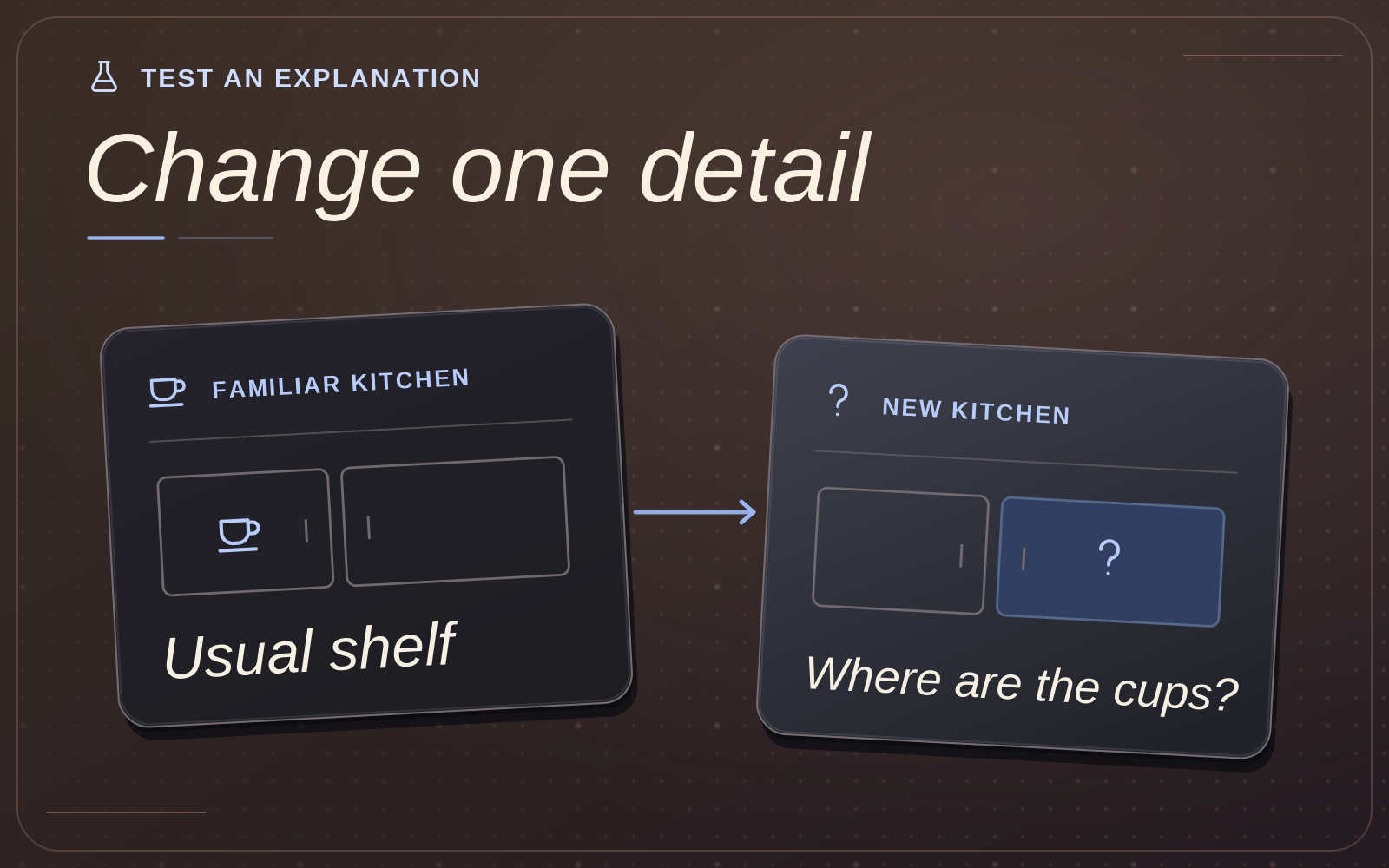
Change one detail that the reason depends on and ask which part of the explanation still holds.
Boiling the kettle starts a sequence you have carried out many times. When reaching for the cup follows, your hand goes to the usual spot. Change one detail. You make tea in a kitchen you have never used. You still know the steps, but you have to stop and ask where the cups are.
A good example gives your explanation somewhere to fail. Go back to the passage. Look for the difference between being able to name the steps and having one familiar move bring on the next.
How do you tell what came from the book?
Find a passage that supports the link you just made and read the lines around it. Check whether your explanation leaves room for the author’s qualifications and separates their reasons from your own.
If your account differs, decide what happened. You may have missed a condition, made an inference or disagreed with the author. Record the difference. You can leave a note that says exactly what you still need to ask instead of filling the gap with a guess.
What have researchers found about explaining as you read?
Prompts to explain improved performance on average across several kinds of learning task.
How much can one fresh example tell you?
One example can show where your own account needs work.
These studies tested explanations during particular learning tasks. How often an adult reader should stop to explain a chapter, and whether changing a detail tests understanding better than a good question about the original, are still open questions.
Keep the example that made you change your answer. It tells you where to start when you try to explain the idea again.
Questions readers ask
Can I use the author's technical terms in my own explanation?
Yes. Keep a term when it lets you say something precisely. Try defining it or showing what changes when it applies.
Does giving one example show that I understand the idea?
It gives you one check. Try a case that nearly fits and check your reasoning against the book.
What if I can repeat the claim but cannot explain the reason?
Keep the claim and write a specific question about the missing reason. Reopen the relevant part of the book to see what support the author gives.
How can someone else help me check my explanation?
Ask them which sentence needs more support or what would make your example fail. Use the book to resolve differences about the author's meaning.
Sources
Studies and reviews say what was measured. Books and guides are where an example or a method comes from. Videos describe one reader's practice: useful, but not evidence.
Review
K. Bisra and colleagues (2018). Inducing self-explanation: a meta-analysis. Educational Psychology Review.
Pooled studies of prompted self-explanation in educational tasks, across levels and outcome measures. Full text read 21 November 2026.
Read the review (opens in a new tab)Study
D. S. McNamara (2004). SERT: self-explanation reading training. Discourse Processes.
Experiment on self-explanation training and comprehension of short science texts. Abstract, participants section and training results read 21 November 2026.
Read the study (opens in a new tab)Book
William James (1890). The Principles of Psychology, chapter IV. Classics in the History of Psychology.
The chapter passage used for the example. Read 21 November 2026.
See the book (opens in a new tab)
Read this with your AI
Opens a new chat with the address of this article and a question ready to send.