How it works
What do I actually do, and why would it work?
An idea is one thing from a book, explained in your own words. It comes back so you can try to say it from memory.
You can also write down and work through ideas from an audiobook, a podcast, a video, a talk or a good conversation.
What does one idea look like?
Your sentence, next to the question the optional AI asked, next to the mark it earned. This is example content, as the app shows it.
Your sentence
We judge an experience by its strongest moment and by how it ends, not by the average. Memory keeps a few snapshots, not the whole film.
The question the optional AI asked
You say memory keeps a few snapshots. What decides which moments become one?
The mark it earned
Held. It came right back.
What are the three steps?
Note it down. Take notes by book and chapter.
Work it out. Explain one idea, link it to something you know and write a question about it.
Explain it.
One idea from the book you just read. What is it, what is the reason behind it, one example. Without looking back.
Connect it.
What does it remind you of? Link it to an idea you already carry, and pick the area of life it belongs to.
Question it.
Write the question you would now ask a colleague, a client or a friend. Yours first. Suggestions only after.
Use it. Try to say the idea before you look. When you use it, note where.
Let it come back.
Your very first idea comes back the next day, the others after about three days. With Premium, the ideas you keep come back again, further apart each time you recall one right away. What was this about, and did it come up since?
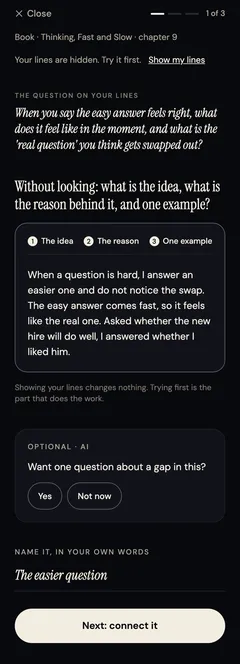
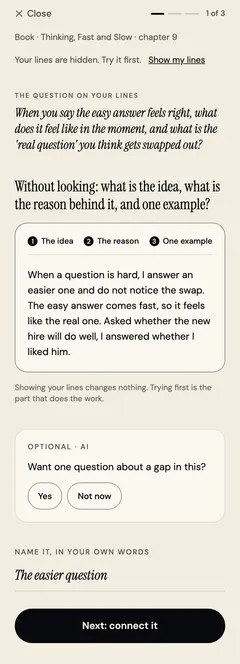
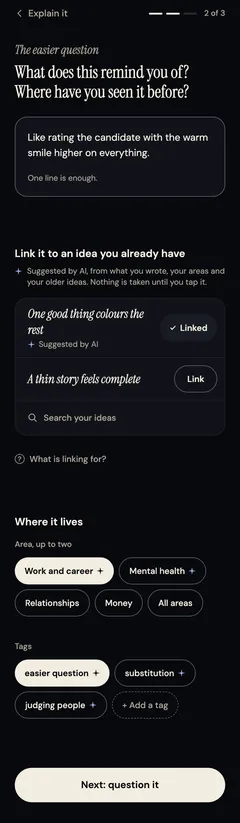
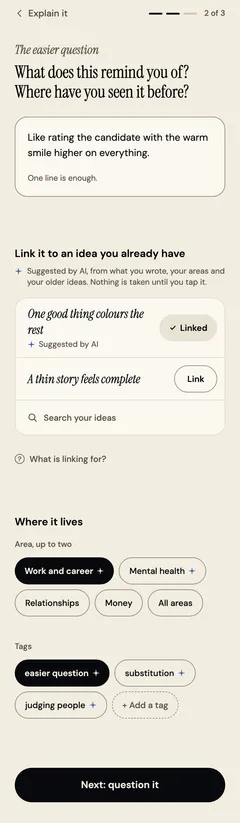
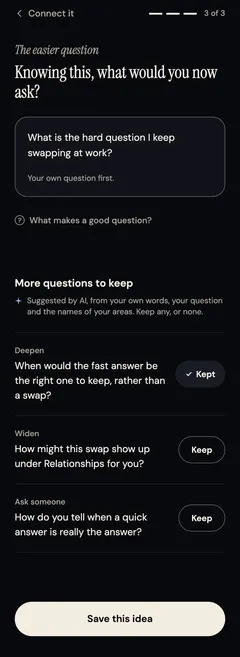
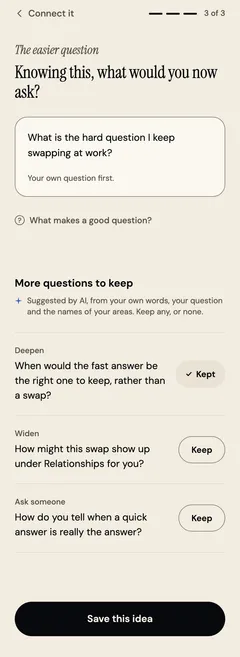
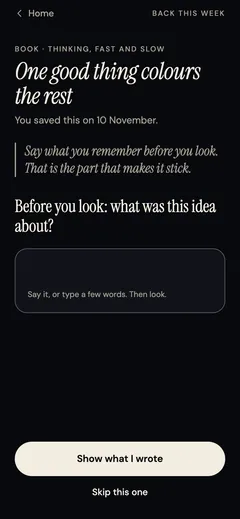
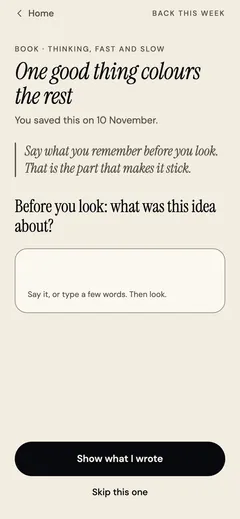
On the couch with your phone. At your desk with your computer.
The web app runs in your browser on your phone and computer, with the same account. At your desk, you can write with your earlier notes and the book’s ideas in view. To pick up on your phone, choose “Continue on your phone”, scan the code and sign in with the same email.
Why it works
Recalling from memory, spaced over time, is among the best-supported ways to learn. Pensaya is built around it.
Explaining it to yourself
Stopping to explain to yourself why or how something works helps you learn it better than just reading on.
Bisra and colleagues, 2018, a review of many studies.
Recalling it from memory
Trying to recall something from memory helps you keep it longer than reading it again.
Roediger and Karpicke, 2006, two experiments. Rowland, 2014, a review of many studies.
Spacing it over time
Spreading your practice over days beats cramming it into one sitting, if you want to remember it later.
Cepeda and colleagues, 2006, a review of studies on remembering words and short texts.
These studies were mostly done with students, many of them at university. Explaining to yourself, connecting ideas and asking your own question have less research behind them than recalling and spacing.
What comes back, and when?
Your book notes are free. So are your first three ideas: you explain each one in your own words, and it comes back to you once, so you can say it from memory. With Premium, the ideas you keep come back again, further apart each time you recall one right away, for as long as you paid for, and there is room for up to 60 new ideas a month. Your very first idea comes back the next day, the others after about three days. With Premium, the gaps between later returns are 10, 30, 60 and 120 days. At most three ideas come back in a week, and I send at most one return reminder in six days. A missed week is a pause, not a debt.
If an idea took a moment, it stays at its step. With Premium, if it is gone for now, it comes back after 4 days and nothing you earned is taken away. "Let it rest" stops returns for an idea until you wake it.
These return days are my own starting schedule. The research on spacing does not show that they are the best ones.
What to do day to day, for each kind of source, is on the how to use page.
What are the four stops in the Wisdom lane?
- Knowledge. The idea is saved with your explanation.
- Understanding. It has a connection, and a question you wrote yourself.
- Held. It came back, and you could say it right away or after a moment.
- Wisdom. It came up in real life, and you noted where.
Marks only go up. A missed week takes nothing away. The card shows the marks and the next step, never a score.
Can I talk instead of type?
Yes. Talking is available to everyone in the web app with a supported browser, including Safari on an iPhone. Tap the microphone when you write a note, in the Explain it step or when an idea comes back. It asks for your yes before you first use it. Your words appear as you speak. There is a daily limit. Your browser sends the sound through our server to Speechmatics in the EU, where it is turned into text. We do not keep the sound.
What does the AI do, and what does it not do?
It asks. Only if you say yes, it points at lines in your notes that look like an idea, asks one question about a gap in your explanation, and suggests an area, tags, up to two of your older ideas and three more questions.
It does not summarise the book. It does not say whether you understood the author correctly. It does not write your thinking for you. What it suggests for your idea (a question, an area, tags, links) is marked as AI.
What does it leave out on purpose?
- No streaks, scores, points or levels.
- No count of waiting ideas, and no backlog.
- No summaries of books or courses.
- No social feed and no public profiles.
- No ads, and no notification that shows what you wrote.