How long should you wait before revisiting a book idea?
Try a question after a gap and use the answer to choose when to try again.
In short
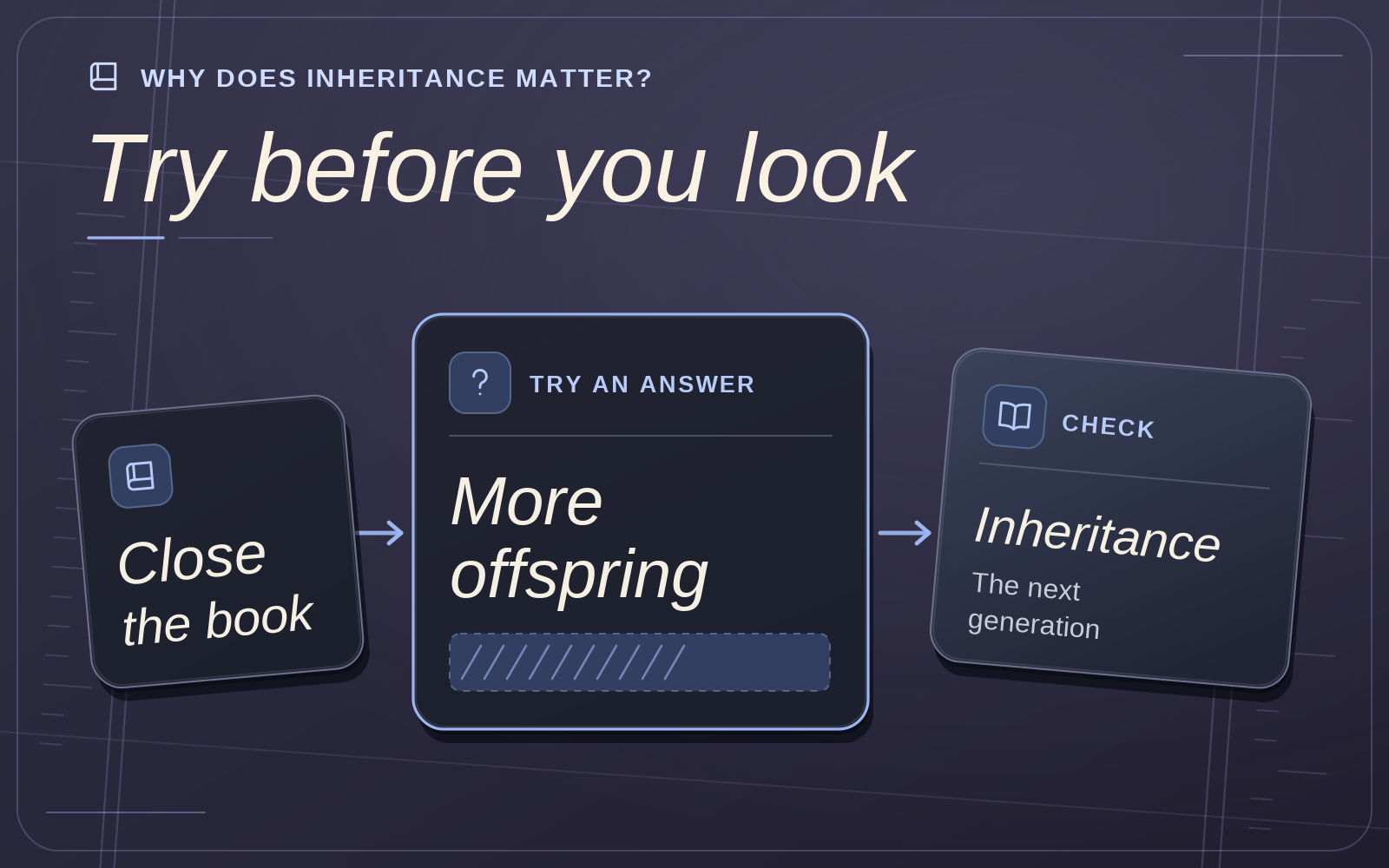
Try reviewing a book idea after a few days by answering one question before you look at your notes.
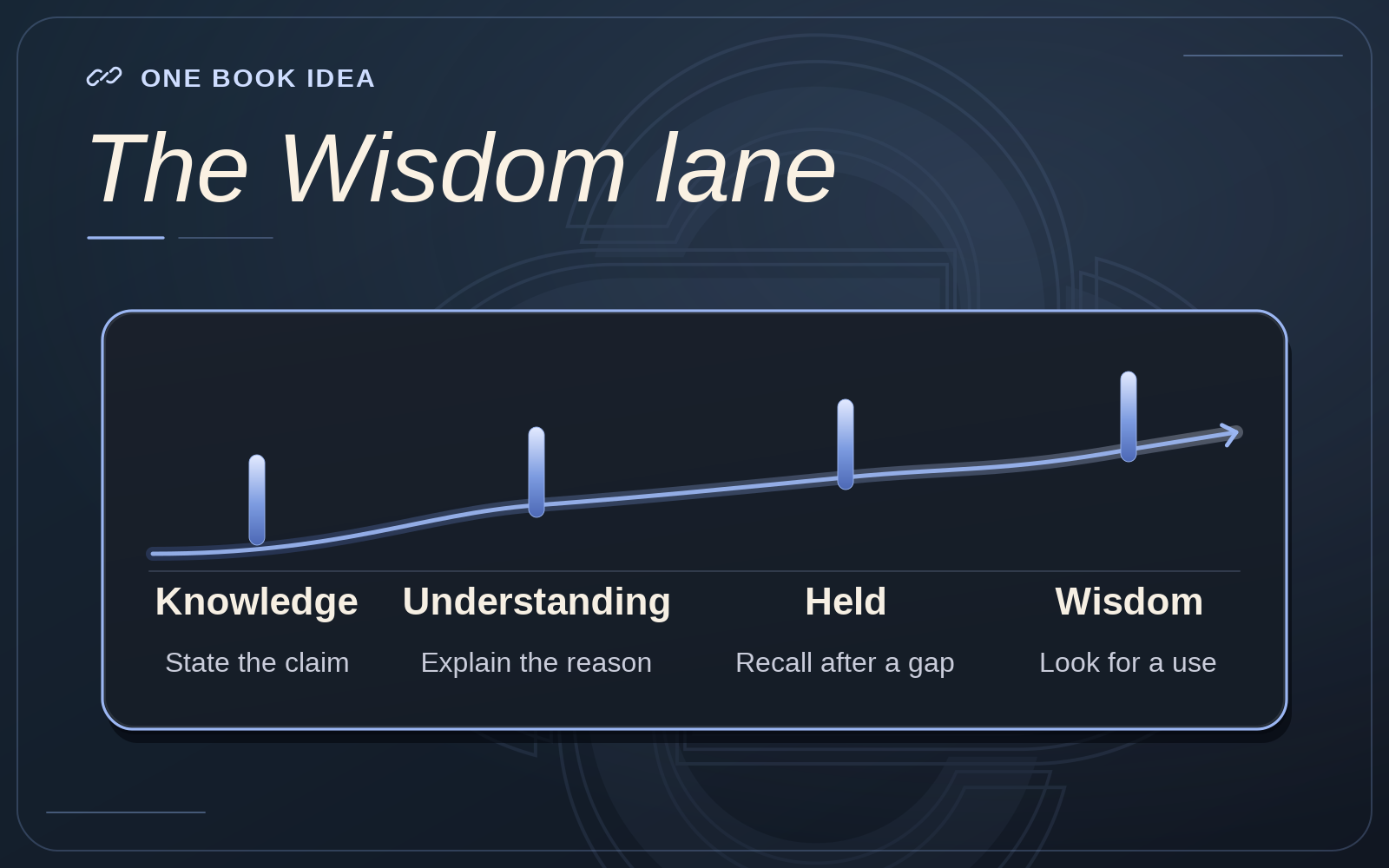
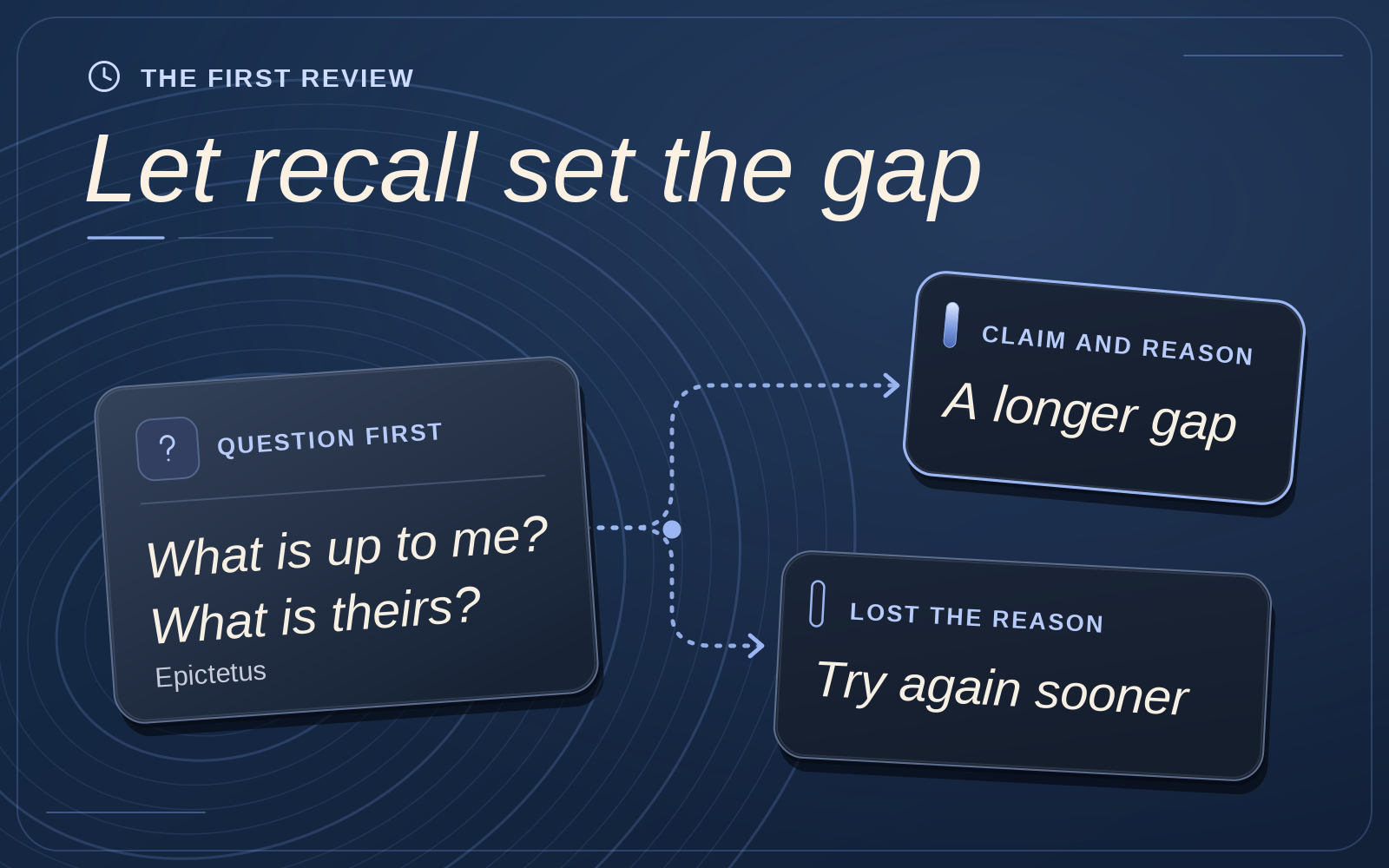
- If you can explain the idea and its reason, try a longer gap.
- If you remember the conclusion but miss the reason, check the passage and try a narrower question sooner.
- A few days is a starting point for your own reading.
On this page
What should come back after the gap?
Keep a question that makes you explain one idea. You open a note from last week and recognise every word. Try the question first and see whether the reason comes back before you read it.
At the start of the Enchiridion, Epictetus separates what depends on us, including our own actions and judgments, from what lies outside our control, including our reputation. Try a question with room for both sides. “When I ask someone to change a decision, what is up to me and what belongs to the other person?” Epictetus, Enchiridion, §1, Elizabeth Carter translation (opens in a new tab).
Save the source and your explanation somewhere apart from the question. Leave enough of a clue to find the idea. Keep the reasoning for your next attempt.
How do you choose the next date?
Use what you could explain before looking to decide when to come back.
Try a first review in a few days. Before you look, say the distinction and give an example. You can choose how to write a reply to a difficult email. The other person decides how to take it. Check the passage, then use what you recalled to choose the next gap.
| What you manage to recall | What to do next |
|---|---|
| You explain the idea and the reason behind it. | Try a longer gap, perhaps a week or two, and bring a new example next time. |
| You recall the conclusion but lose the reason. | Check the source and narrow the next question to the missing link. Try again sooner. |
| You draw a blank. | Read the relevant paragraph, close it and try a short explanation. Make the cue more specific for the next review. |
| You no longer have a use for the idea. | Keep the reference if you want it. Take the question out of your calendar. |
These intervals are starting points for your own calendar. If you want to have an idea to hand at a particular event, set a review before it.
What should you change at the next review?
Change the situation and see whether the same reason still fits.
Suppose a meeting ends with a decision you disagree with. Name one action you can take and one outcome you cannot decide. Then change a detail. You are now the person who has the final say. Which part of the distinction changes? A fresh example makes you work out what the words mean again.
Does a longer gap always help?
The best interval in a set of trivia tests depended on how long the answer needed to last.
That pattern comes from a large body of research on verbal recall. It does not set an interval for a particular idea you read.
These estimates came from trivia tests. Use the reading intervals above as rules of thumb. The study did not test the notebook routine here.
This compares two practice decisions for a procedure. It gives no best interval for an idea from a book.
Is there a tested schedule for book ideas?
The studies establish patterns for particular tasks and leave this reading routine open.
The size and timing of an effect depend on what participants practise and what the final test asks. There is no tested schedule here for repeating an explanation, trying a new example and noticing when a book idea fits a decision.
Pick one idea you still want to discuss or try. Put the question somewhere you will find it in a few days.
Questions readers ask
Do I need flashcards to review book ideas?
No. You can keep a question on your calendar and its explanation on a page in your notebook.
What if I miss a review?
Try it when you next see the question. Use what you can explain at that point to choose another date.
Do the gaps between reviews always have to get longer?
No. A longer gap is one choice after a good recall attempt. A shorter gap can make sense if you lose the reason or have a particular date when you will need it.
Should I schedule a review for every book note?
Keep a review for ideas you still want to recall. Let your source notes do their job of pointing you back to the book.
Sources
Studies and reviews say what was measured. Books and guides are where an example or a method comes from. Videos describe one reader's practice: useful, but not evidence.
Review
N. J. Cepeda and colleagues (2006). Distributed practice in verbal recall tasks: a review and quantitative synthesis. Psychological Bulletin.
Meta-analysis compared the effects of different practice intervals on recall of verbal material in experiments with varied age groups. Full text read 21 November 2026.
Read the review (opens in a new tab)Study
N. J. Cepeda and colleagues (2008). Spacing effects in learning: a temporal ridgeline of optimal retention. Psychological Science.
One experiment tested trivia recall and recognition in adults aged 18–72 across different study gaps and final test delays. Full text read 21 November 2026.
Read the study (opens in a new tab)Study
D. Rohrer and K. Taylor (2006). The effects of overlearning and distributed practise on the retention of mathematics knowledge. Applied Cognitive Psychology.
Original experiments on mathematics problems. Abstract and discussion read on 21 November 2026.
Read the study (opens in a new tab)Book
Epictetus (1758). Enchiridion, §1, Elizabeth Carter translation. The Internet Classics Archive (MIT).
The passage used for the example. Read 21 November 2026.
See the book (opens in a new tab)
Read this with your AI
Opens a new chat with the address of this article and a question ready to send.