Why close the book when rereading feels easier?
Recall one idea from a book with the page closed, then check the answer against the passage.
In short
Retrieval practice means trying to bring an answer to mind before you look it up.
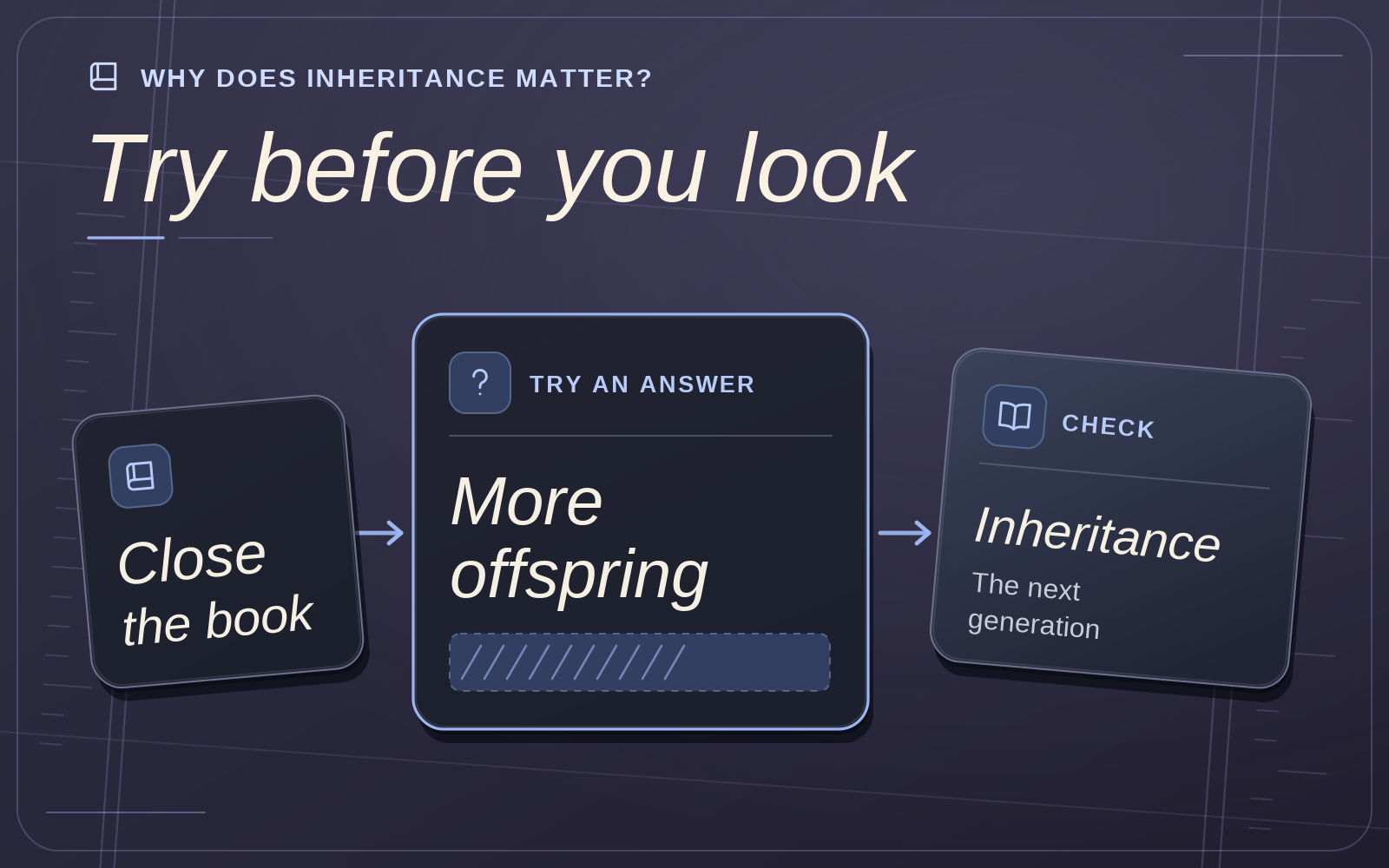
- After reading, close the book and answer one question about an idea or the reason behind it.
- Say what you can, then reopen the passage to check the part you missed.
- Save the question for another day.
On this page
What is retrieval practice after reading a book?
Retrieval practice is trying to bring an answer to mind before you look. You remember that a trait helped an animal survive. A day later, can you say why that trait might become more common in the next generation?
Give yourself a question small enough to answer aloud. “What did the chapter cover?” can work for an outline. “Why does it matter whether offspring inherit the trait?” asks for a reason.
Say what you can while the book is closed. If you have half an answer, write down where it stops. Open the book to check that part, then keep the question by itself for another day.
What does it look like to recover a missing reason?
Name the point where your explanation stops, then look for that step in the book.
After chapter IV of On the Origin of Species, close the book and ask why a useful variation, on its own, does not explain how a trait becomes more common over generations. Charles Darwin, On the Origin of Species, first edition (1859), ch. IV (opens in a new tab).
A partial answer might be: Individuals with a variation that helps in the local conditions may leave more offspring. I still need to explain why the next generation would resemble them. When you reopen the chapter, find where Darwin connects preservation to inheritance. Put the missing link into your answer.
For another day, give yourself a question that brings back the full reason. Why does it matter whether offspring inherit a trait that helped their parents? Review your answer against the same passage. If you keep leaving out the change in conditions, give that part its own question.
When did recall help more than rereading?
In two experiments on short science passages, recall practice helped more on delayed tests while rereading helped more on a test five minutes later.
The studies asked students to remember short science passages. In this exercise, the final check shows you what you left out.
Try out the skill itself if performing it is what you want to check.
What can you tell from a closed-book answer?
One question shows which part of an explanation you can bring back on that attempt.
A closed-book question gives you a way to see which part of the account you can bring back. The short-passage studies leave open how best to test your reading of a whole book, and how often a good answer to a written prompt prepares you to use the idea in real life.
Save the question you could not yet answer fully. It gives your next attempt a place to begin.
Questions readers ask
Can I practise recall out loud?
Yes. You can try to answer out loud. Writing leaves a record you can compare with the passage.
When is rereading useful?
Reopen the passage to fix a mistake, recover a missing detail or check the author's exact wording.
What should I do if I cannot recall an answer?
Look for a small cue, like the chapter title or the question you saved. If you are still blank, read the relevant lines, put the book down and give the question another go.
How is retrieval practice different from spaced repetition?
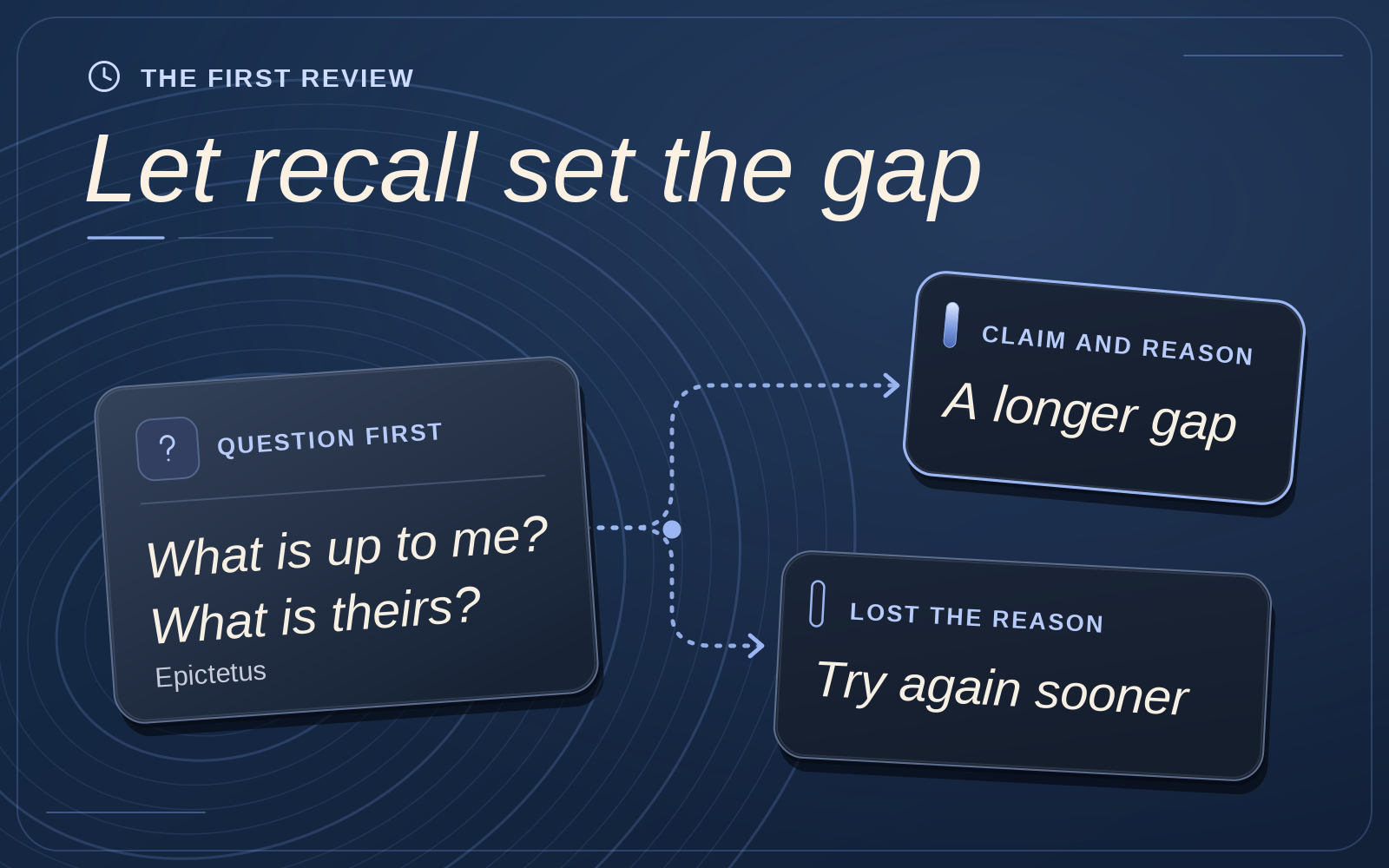
Retrieval practice is what you do when you try to recall the answer. Spacing is about when you return to it. You can use both by answering again after a gap.
Sources
Studies and reviews say what was measured. Books and guides are where an example or a method comes from. Videos describe one reader's practice: useful, but not evidence.
Study
H. L. Roediger III and J. D. Karpicke (2006). Test-enhanced learning: taking memory tests improves long-term retention. Psychological Science.
Two experiments measured recall of short science passages in Washington University undergraduates after different delays. Full text read 21 November 2026.
Read the study (opens in a new tab)Study
T. van Gog and colleagues (2015). Testing after worked example study does not enhance delayed problem-solving performance compared to restudy. Educational Psychology Review.
Four original worked-example experiments. Abstract read 21 November 2026.
Read the study (opens in a new tab)Book
Charles Darwin (1859). On the Origin of Species, first edition, chapter IV. John Murray (Darwin Online).
The chapter passage used for the example. Read 21 November 2026.
See the book (opens in a new tab)
Read this with your AI
Opens a new chat with the address of this article and a question ready to send.