What ten videos show about reading, and where research pushes back
Compare how readers mark, explain and revisit passages, and see what the experiments measured.
In short
Give each reading habit a job.
- Mark a passage so you can find it again.
- Explain the reason behind one claim and check it against the book to see where your account needs work.
- After a gap, try to recall the idea with the book closed, then reopen it to check what you missed.
- The ten video demonstrations show different ways to do this, while the studies measure particular tasks under particular conditions.
On this page
A paragraph you marked on Sunday looks familiar on Friday. Can you explain what it was doing in the argument? The ten videos here show ways to work on a book. The experiments ask what those moves help people do under particular conditions.
The ten demonstrations cover reading and working with notes from books. To judge what a habit achieves, look at what the researchers asked people to do and what they measured afterwards.
When is a mark enough?
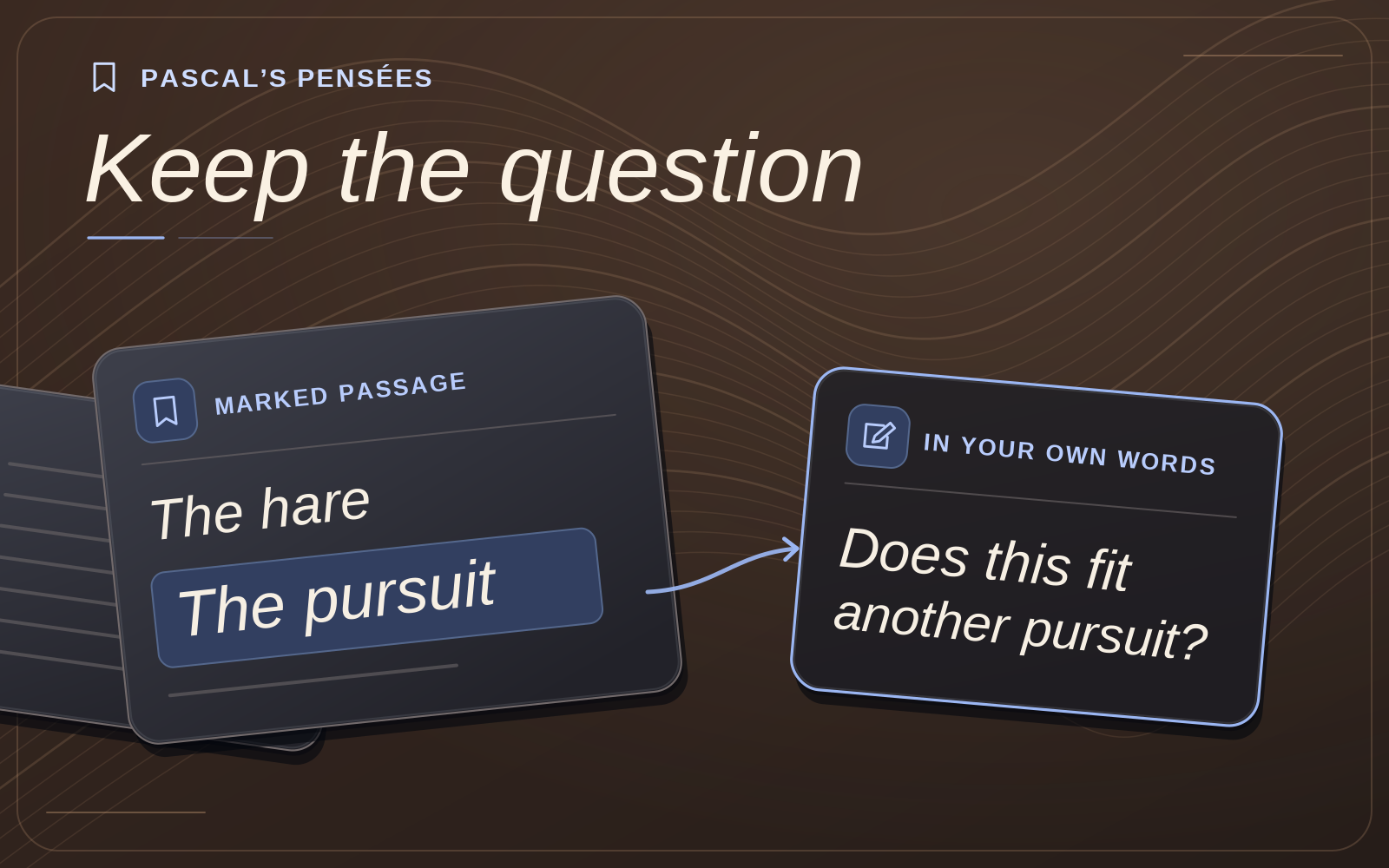
A mark is enough when you want to find the passage again. Ryan Holiday treats the page as a working surface. Cal Newport makes a mark at the corner of a page he wants to find again, then marks the relevant line. Studyign keeps reader comments in one margin and short accounts or passages in the other. They give a mark a limited job. You can find the place later without stopping to write a full account now. Holiday, marking a book (opens in a new tab) · Newport, two kinds of marks (opens in a new tab) · Studyign, two margins (opens in a new tab)
Highlighting sometimes helps on a memory test.
The test asked students to fill in missing words. Explaining how groundwater moves would have been a different test.
That rating considers how well a technique travels across people, material and tasks.
Try giving your next mark one job. Put it beside a sentence you may need to find again. A question in the margin can tell you why you marked it.
How can you see whether you understand the reason?
Say how one point follows from another. Robin Waldun looks for the argument of a chapter and numbers the points that carry it. Jeffrey Kaplan builds a running margin account by working the new paragraph into what came before. Odysseas adjusts his explanation for different listeners. Waldun, tracing the argument (opens in a new tab) · Kaplan, cumulative notes (opens in a new tab) · Odysseas, changing audience (opens in a new tab)
The study tested understanding of one system after a prompted reading task.
If you try self-explanation on a chapter, choose the one link you find hardest and check it against the text.
A summary can tell you what the chapter covers. To check your explanation, add one sentence that starts with because. Check against the text whether your reason is one the author gives or one you supplied.
What happens when you try before you look?
An attempt with the book closed gives you a check on what you can say without its help. English with Emma’s SQ3R routine includes answering a question at the end of reading, then checking the source. Newport uses a related idea when looking for notes. He first tries to remember which book mattered, then revisits the markings. Emma, recite and review (opens in a new tab) · Newport, remember the book (opens in a new tab)
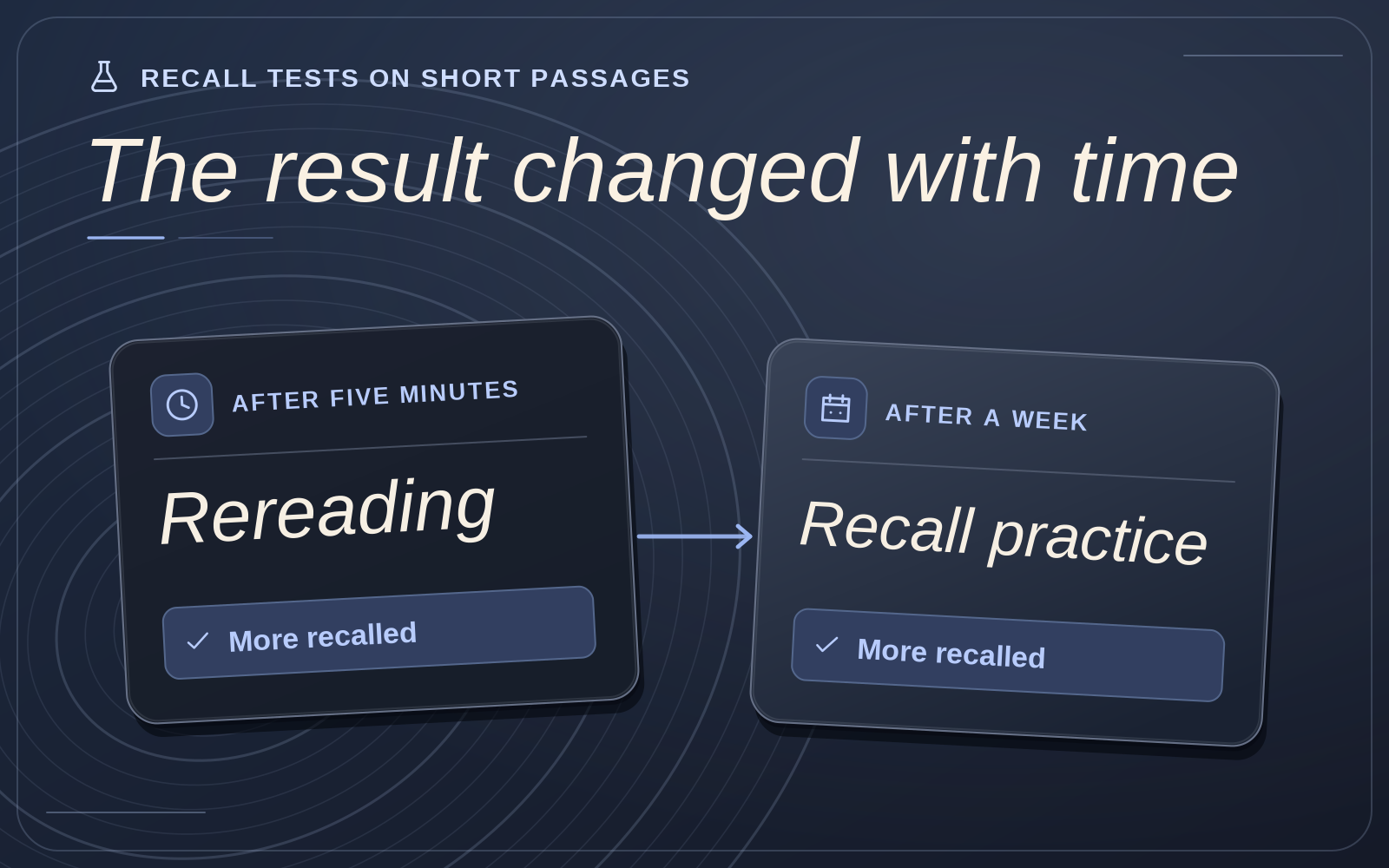
The researchers scored recalled points from short passages. The most useful result for a reader is the change with time. An exercise that feels productive with the book still fresh can give a different result a week later.
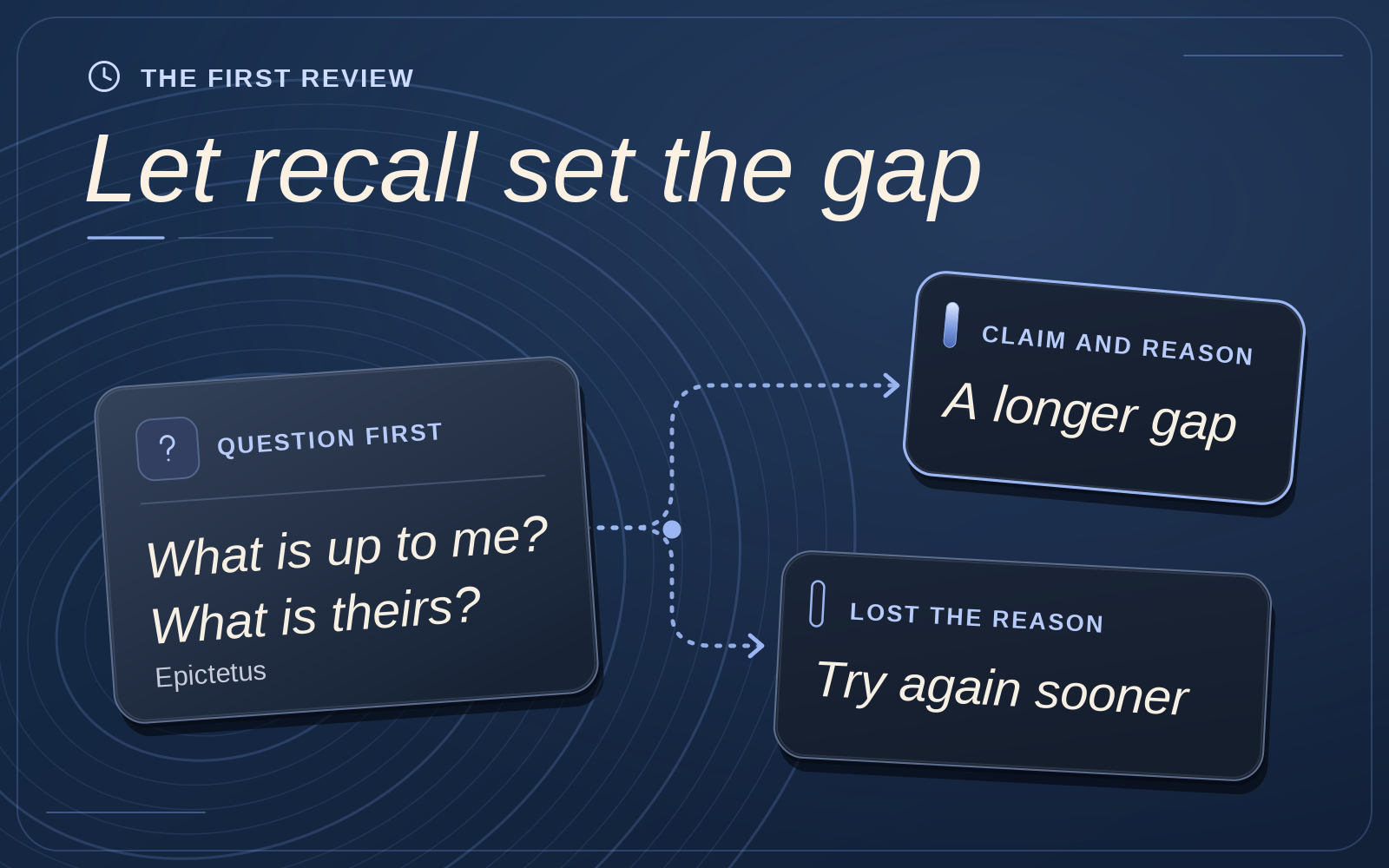
A delay also changes what counts as a sensible time to return.
Their finding comes from a fact-learning task. For a book idea, try one return a few days later and check how much of the reasoning you can reconstruct.
What can a new example tell you?
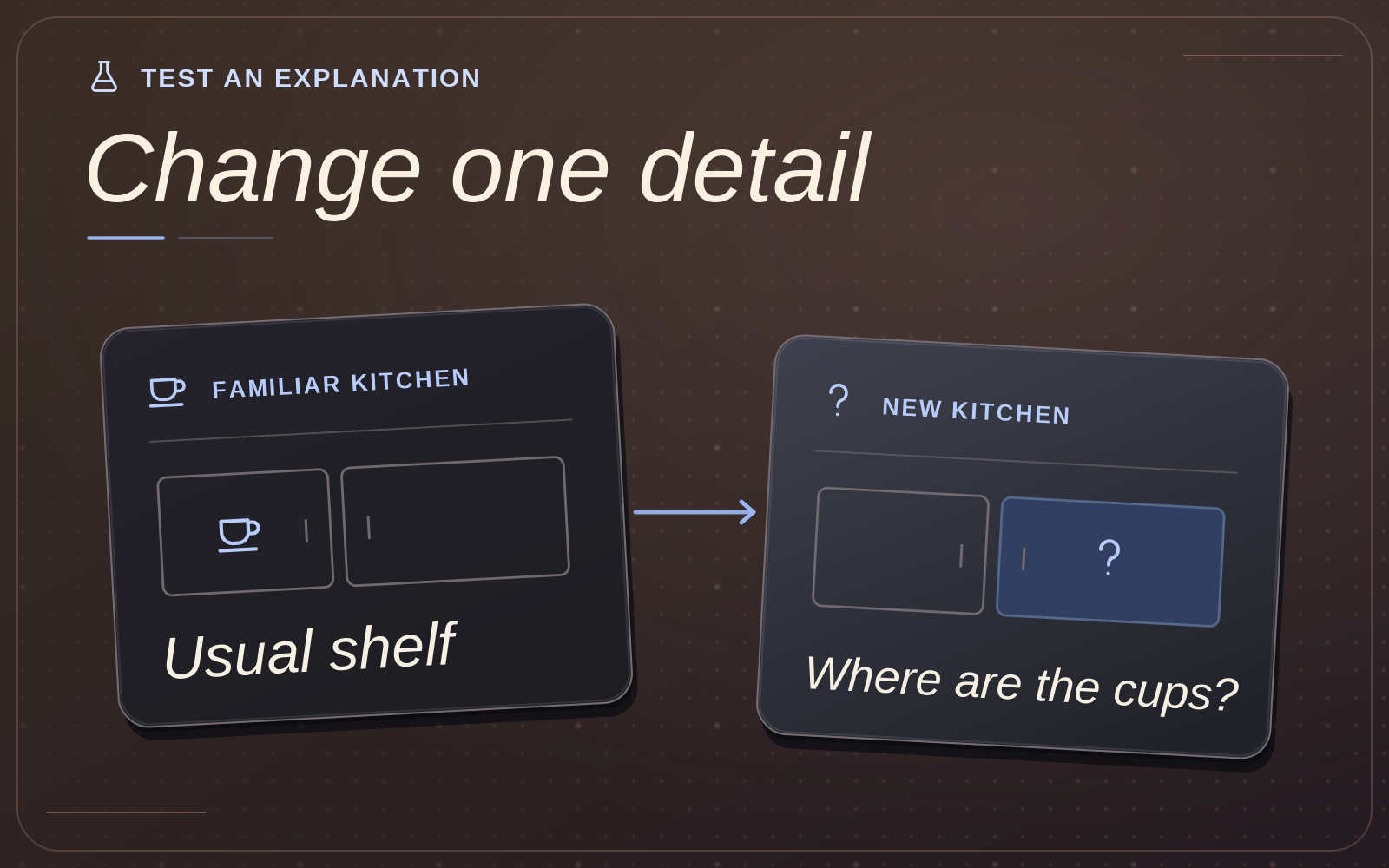
A new example lets you check what has to stay true when the details change. Vicky Zhao proposes looking for an opposite idea, a related one, a wider question or an implication. If you take one argument from a chapter, pick a case the author never used and say what carries over. Zhao, the idea compass (opens in a new tab)
The comparison changes when both groups get help finding the important part. When you try a second example, check the original again afterwards so you can see which condition you missed.
Three decisions you can make on the page
| Decision | One approach | Another approach |
|---|---|---|
| How often should you pause? | Jeffrey Kaplan keeps a running account of a dense argument. At each new paragraph, he writes a sentence for the material so far and one for the new paragraph. Kaplan, section from 04:49 (opens in a new tab) | Cal Newport makes sparse pencil marks. A mark at the corner locates the page, and a mark inside locates the passage. Newport, 07:37 (opens in a new tab) |
| Should you close the book before writing? | English with Emma closes the book and tries to answer earlier questions from memory as part of SQ3R, a five-step textbook reading method. Emma, 09:41 (opens in a new tab) · Cornell SQ3R guide (opens in a new tab) | In one textbook routine, Frank reopens the chapter and writes notes on the chapter. Frank, 05:25 (opens in a new tab) |
| What makes a passage worth keeping? | Ryan Holiday asks what use the information could have. Holiday, about 09:59 (opens in a new tab) | Vicky Zhao gives a note one idea and a source she can return to. Zhao, 02:08 (opens in a new tab) |
One book, four things to try
Benjamin Franklin describes giving each part of his day a place in a schedule. When he writes about trying to practise order, he explains why keeping regular hours was difficult in a trade that depended on other people’s schedules. That gap between the plan and the day gives you something specific to work with. Franklin, Autobiography, “Plan for Attaining Moral Perfection” (opens in a new tab).
| Job | What to write or try |
|---|---|
| Find the passage | Mark Franklin’s daily schedule and the later paragraph on difficulties in his trade. |
| Explain the link | A schedule can assign work a time. It is harder to keep that time when part of the work arrives on somebody else’s timetable. |
| Return to it | Close the book. What made order harder for Franklin to practise than it looked on paper? Reopen the passage and check what you missed. |
| Try another case | Put a regular task on the calendar for one week. Name one unpredictable request that could displace it and decide where the task could go if that happens. |
A page marker will take you back to Franklin’s schedule. An explanation can help you see what the schedule has to survive.
Where the evidence stops
The videos show ways committed readers work. The experiments compare particular tasks with particular tests. Whether one notebook routine is worth keeping depends on the book, what you want from it and which work you can see yourself doing again. Try the smallest part your next chapter calls for, then check your answer with the book open.
Questions readers ask
Do the ten reading videos recommend the same routine?
They show different ways to choose useful passages, make sense of a hard argument and check what you can say later. Try one move on a real chapter before adopting the whole routine.
When should I close the book before writing?
Open the book when you are still checking what the author means. When you have a question you could answer, close it for one attempt and compare that answer with the passage.
Should I read every nonfiction book the same way?
Give your next move the job you need done. A short mark can serve a quotation. A question about the reasoning may need a slower pass.
Sources
Studies and reviews say what was measured. Books and guides are where an example or a method comes from. Videos describe one reader's practice: useful, but not evidence.
Study
C. L. Yue and colleagues (2015). Highlighting and its relation to distributed study and students' metacognitive beliefs. Educational Psychology Review.
Students studied a text about groundwater, with or without highlighting, and filled in missing keywords a week later. Methods and results read in the full paper on 21 November 2026.
Read the study (opens in a new tab)Review
J. Dunlosky and colleagues (2013). Improving students' learning with effective learning techniques: promising directions from cognitive and educational psychology. Psychological Science in the Public Interest.
A broad review that rated learning techniques by how well each travels across people, material and tasks. Full text read 21 November 2026.
Read the review (opens in a new tab)Study
M. T. H. Chi and colleagues (1994). Eliciting self-explanations improves understanding. Cognitive Science.
Eighth-grade students either explained each line of a passage about circulation to themselves or read it twice, with a pretest and a posttest. Full text read 21 November 2026.
Read the study (opens in a new tab)Study
A. Lachner and colleagues (2021). Learning by writing explanations: is explaining to a fictitious student more effective than self-explaining?. Learning and Instruction.
A lab experiment and a field experiment compared written teaching, written self-explanation, written retrieval and a baseline. Abstract and general discussion read in the full paper on 21 November 2026.
Read the study (opens in a new tab)Study
H. L. Roediger III and J. D. Karpicke (2006). Test-enhanced learning: taking memory tests improves long-term retention. Psychological Science.
Two experiments scored the points students recalled from short prose passages after different delays. Full text read 21 November 2026.
Read the study (opens in a new tab)Study
N. J. Cepeda and colleagues (2008). Spacing effects in learning: a temporal ridgeline of optimal retention. Psychological Science.
Participants learned facts, had one review after a gap and took a final test later.
Read the study (opens in a new tab)Study
G. G. van Eersel and colleagues (2016). The testing effect and far transfer: the role of exposure to key information. Frontiers in Psychology.
Experiments on using an idea in another domain compared retrieval practice with feedback and rereading, tested after a week.
Read the study (opens in a new tab)Book
Benjamin Franklin. Autobiography, chapter IX. Manifold (public domain edition).
The schedule and the passage about his trade, used for the example. Read 21 November 2026.
See the book (opens in a new tab)Guide
Cornell Learning Strategies Center. Textbook Reading Systems. Cornell University.
A university guide to SQ3R, a five-step textbook reading method.
Read the guide (opens in a new tab)Video
Ryan Holiday (2026). Give me 16 minutes and I'll teach you how to read like a PRO. YouTube.
Leave marks you can work with later. Caption passage at the linked time read 21 November 2026. A practice, not a study.
Watch the part (opens in a new tab)Video
Robin Waldun (2022). How To Get The Most Out of A Book: Analytical Reading 101. YouTube.
Find the argument and the points that support it. Caption passage at the linked time read 21 November 2026. A practice, not a study.
Watch the part (opens in a new tab)Video
Jeffrey Kaplan (2021). Lecture #9: How to Read so that you Retain Information. YouTube.
Add each paragraph to a running account. Caption passage at the linked time read 21 November 2026. A practice, not a study.
Watch the part (opens in a new tab)Video
English with Emma (2026). Understand and Remember What You Read!. YouTube.
Answer from memory, then review. Caption passage at the linked time read 21 November 2026. A practice, not a study.
Watch the part (opens in a new tab)Video
Cal Newport (2024). A Productivity System To Remember Everything You Learn & Get Ahead In Life. YouTube.
Mark a page and a line for different jobs. Caption passage at the linked time read 21 November 2026. A practice, not a study.
Watch the part (opens in a new tab)Video
Thomas Frank (2014). 5 Active Reading Strategies for Textbook Assignments. YouTube.
Work back from the chapter's questions. Caption passage at the linked time read 21 November 2026. A practice, not a study.
Watch the part (opens in a new tab)Video
Vicky Zhao (2022). 2023 Zettelkasten Obsidian Workflow: Simple Set Up. YouTube.
Look in four directions for a link. Caption passage at the linked time read 21 November 2026. A practice, not a study.
Watch the part (opens in a new tab)Video
Odysseas (2024). The Feynman Technique, timeless & effective. YouTube.
Explain the same idea for another reader. Caption passage at the linked time read 21 November 2026. A practice, not a study.
Watch the part (opens in a new tab)Video
Vicky Zhao (2021). Zettelkasten Method Explained: A Beginner's Guide. YouTube.
Put an idea from a source in your own words and record where it came from. Caption passage at the linked time read 21 November 2026. A practice, not a study.
Watch the part (opens in a new tab)Video
Studyign (2016). how to annotate. YouTube.
Use the margins for a response and a record. Caption passage at the linked time read 21 November 2026. A practice, not a study.
Watch the part (opens in a new tab)
Read this with your AI
Opens a new chat with the address of this article and a question ready to send.