What to write after a chapter when you have too much to say
Write the chapter’s point in your own words, keep a passage to check it and add one question of your own.
In short
Start a chapter note with one sentence in your own words about what the author was trying to show.
- Add a page, heading or passage that helps you check that sentence, with a few words about what the passage does.
- If the chapter leaves you with a question worth following, give the question its own line.
On this page
What goes in the first line?
Start with what the author was trying to show. Picture the end of a chapter where you have marked several passages, but your notes still only name the subject.
Put the book down and finish this sentence in your head. “I think this chapter was trying to show that…”
Use a verb that fits the chapter. Did the author trace a cause, separate two ideas that sound alike or use a story to show how something works? If your sentence could describe the whole book, make it a little more specific. If the chapter raises a question that it only answers later, keep the question.
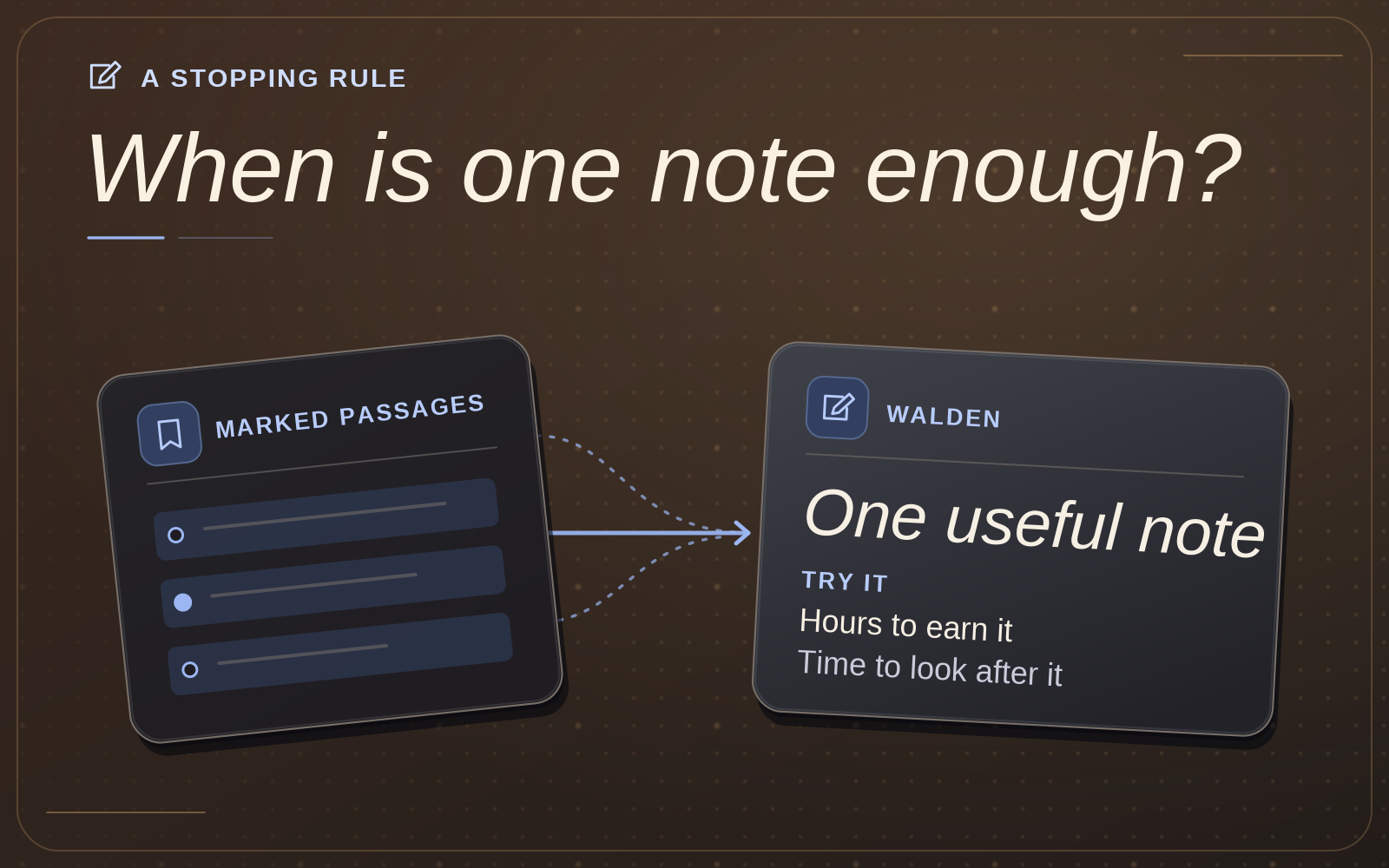
Robin Waldun shows one way to do this when a chapter is dense. He finds the claims that carry the argument and uses the marks he made while reading to write a chapter account. His marks help him get back to the places that mattered. Robin Waldun, 02:15 on the argument and 04:19 on the chapter account (opens in a new tab).
Which passage should you keep?
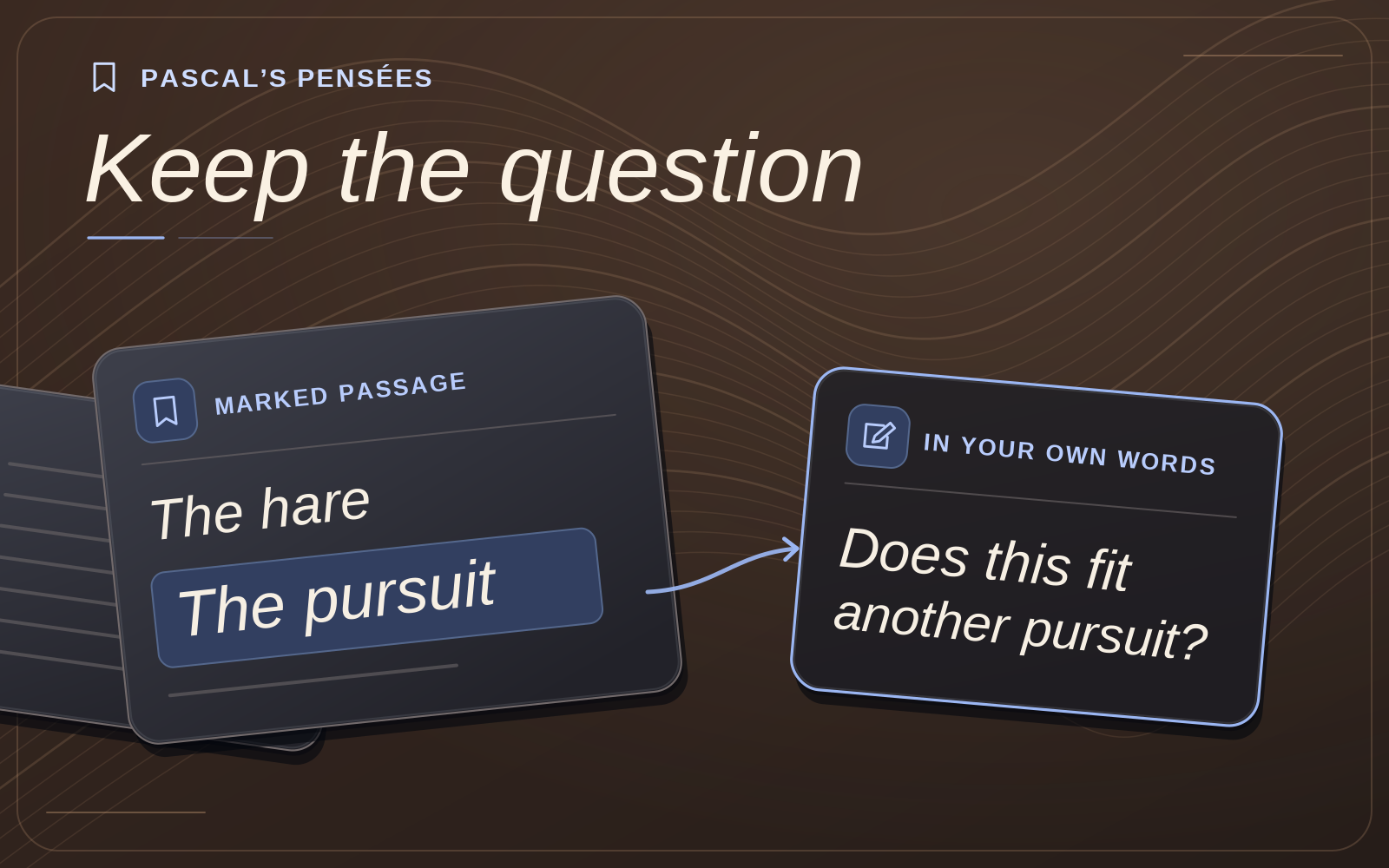
Keep a passage that helps you test your reading of the chapter.
Find a passage that supports your reading. Write its page or heading and what it does for your sentence. A story might illustrate a claim. A comparison may help explain it. The two have different jobs.
Add a word to the page reference that names its job, such as evidence, definition or exception. If a later chapter answers an open question, keep the original question and point to the later passage.
Look for one qualification you might have missed. “Some people” and “everyone” make different claims. If you cannot find support for part of your sentence, change it or keep it as a question.
What does a three-line chapter note look like?
Give the claim, the passage and your own question a line each.
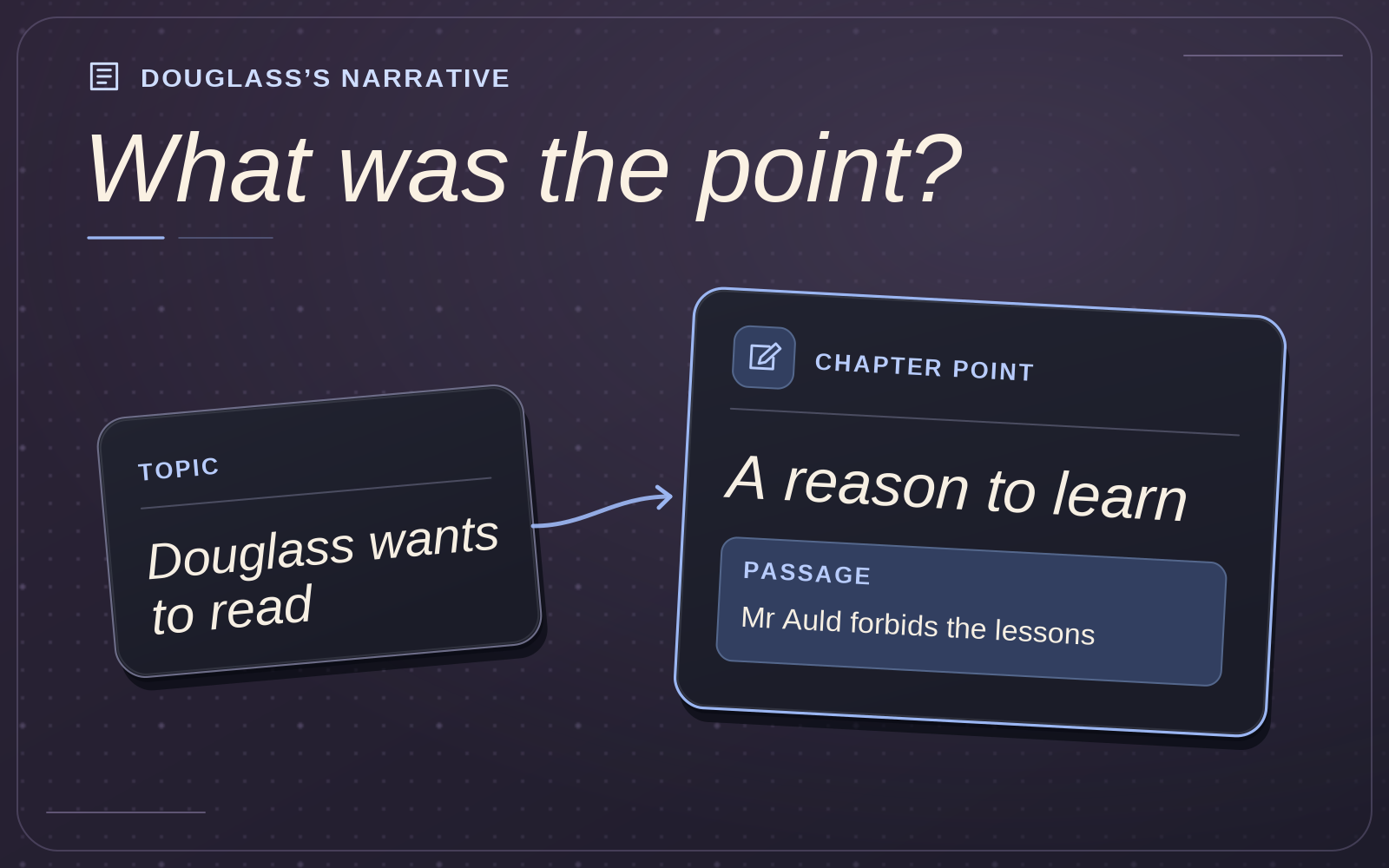
In chapter VI of his Narrative, Frederick Douglass remembers Mrs Auld beginning to teach him to read and Mr Auld forbidding her to continue. A note saying “Douglass wants to read” gets the subject. To get the point, follow what he learns from hearing the prohibition. Frederick Douglass, Narrative of the Life of Frederick Douglass, an American Slave (1845), ch. VI (opens in a new tab).
| Part of the note | Example |
|---|---|
| What the chapter was doing | Douglass shows how a man trying to keep him from reading gave him a reason to learn. |
| Where I saw it | Mr Auld fears that literacy would make Douglass harder to control. Douglass takes that fear as evidence of what learning to read could mean for him. |
| What I want to ask | How does Douglass show the difference between his younger self’s experience and the way he understands it as he writes? |
The first two lines tell you where the point came from. The third gives you a reason to open the book again. When a later chapter changes your reading, keep the source and add the correction below the original note.
Does closing the book help?
The practice of recalling a short passage helped students answer questions about it on a later test.
Try the same look-away step when you draft a sentence. Cornell includes it in a guide for reading textbooks. Cornell’s SQ3R guide (opens in a new tab).
What can a short chapter note leave open?
Leave a question open when the chapter gives you a reason to keep reading.
The experiment used short texts. It leaves open which parts of a long chapter a reader should try to recall, which note format serves a book best and whether keeping a question alongside a claim improves a discussion.
Try three lines the next time a chapter gives you something worth following. Once you have the claim, a way back and a question, turn the page.
Questions readers ask
Should I take notes after every chapter?
Write when you have something to check, keep or ask. Sometimes the natural pause comes earlier or later.
What if I cannot sum up the chapter?
Write where you lost the thread. Keep the heading or passage so you can pick up the same question later.
Can I write a note with the book open?
Yes. For an interpretation, you may want the passage in front of you. Close the book first when you want to find out what you can bring to mind.
Should I include a page number in my chapter note?
Keep it when you want to check exact wording or evidence later. For an ebook, a chapter and heading may be easier to find.
Sources
Studies and reviews say what was measured. Books and guides are where an example or a method comes from. Videos describe one reader's practice: useful, but not evidence.
Study
J. D. Karpicke and J. R. Blunt (2011). Retrieval practice produces more learning than elaborative studying with concept mapping. Science.
Original experiments on studying short science texts and a one-week test. Full text read 21 November 2026.
Read the study (opens in a new tab)Book
Frederick Douglass (1845). Narrative of the Life of Frederick Douglass, an American Slave, chapter VI. Wikisource.
The chapter passage used for the example. Read 21 November 2026.
See the book (opens in a new tab)Guide
Cornell Learning Strategies Center. Textbook Reading Systems. Cornell University.
A university teaching guide to reading textbooks, including the look-away step. Full guide read 21 November 2026.
Read the guide (opens in a new tab)Video
Robin Waldun (2022). How To Get The Most Out of A Book: Analytical Reading 101. YouTube.
Practitioner demonstration. Captions at 02:15 and 04:19 read 21 November 2026. A practice, not a study.
Watch the part (opens in a new tab)
Read this with your AI
Opens a new chat with the address of this article and a question ready to send.