How do you save a book quote that still makes sense a month later?
Save a book quote with its location, the context around it and your own reason for keeping it, so it still reads right later.
In short
Save the words, where they came from and one sentence about why you chose them.
- Keep the surrounding qualification if it changes the meaning.
- Put your own reading of the passage on a separate line so you can check it later.
On this page
What should go beside a quote?
Keep enough context to answer three questions. Who is speaking? What are they doing in this part of the book? Where do I find the words again? Use the author, title, chapter and page or ebook location. If an edition matters, note it. For a book without convenient page numbers, record a section heading and a phrase near the start of the passage.
Name why you saved it before you close the book. “An example of an author changing her mind” gives you something to look for. A tag such as “work” can help you find it among other notes, but it leaves that decision for later.
You can do this on paper, in a digital note or in the margin. Readwise Reader, for example, describes adding a note to an existing highlight. The fields work the same way in an ordinary notebook. Readwise Reader documentation, checked 21 November 2026 (opens in a new tab)
What goes wrong when you save only the striking line?
You lose the clue that tells you whether the words are a claim, somebody else’s position or an idea the author is about to reconsider. Before saving, read one sentence on either side. Keep a short context note if the surrounding text changes what the line says. If the author quotes another person, preserve that attribution too.
One more line in the note can save a second search through the book.
How would that work on a real page?
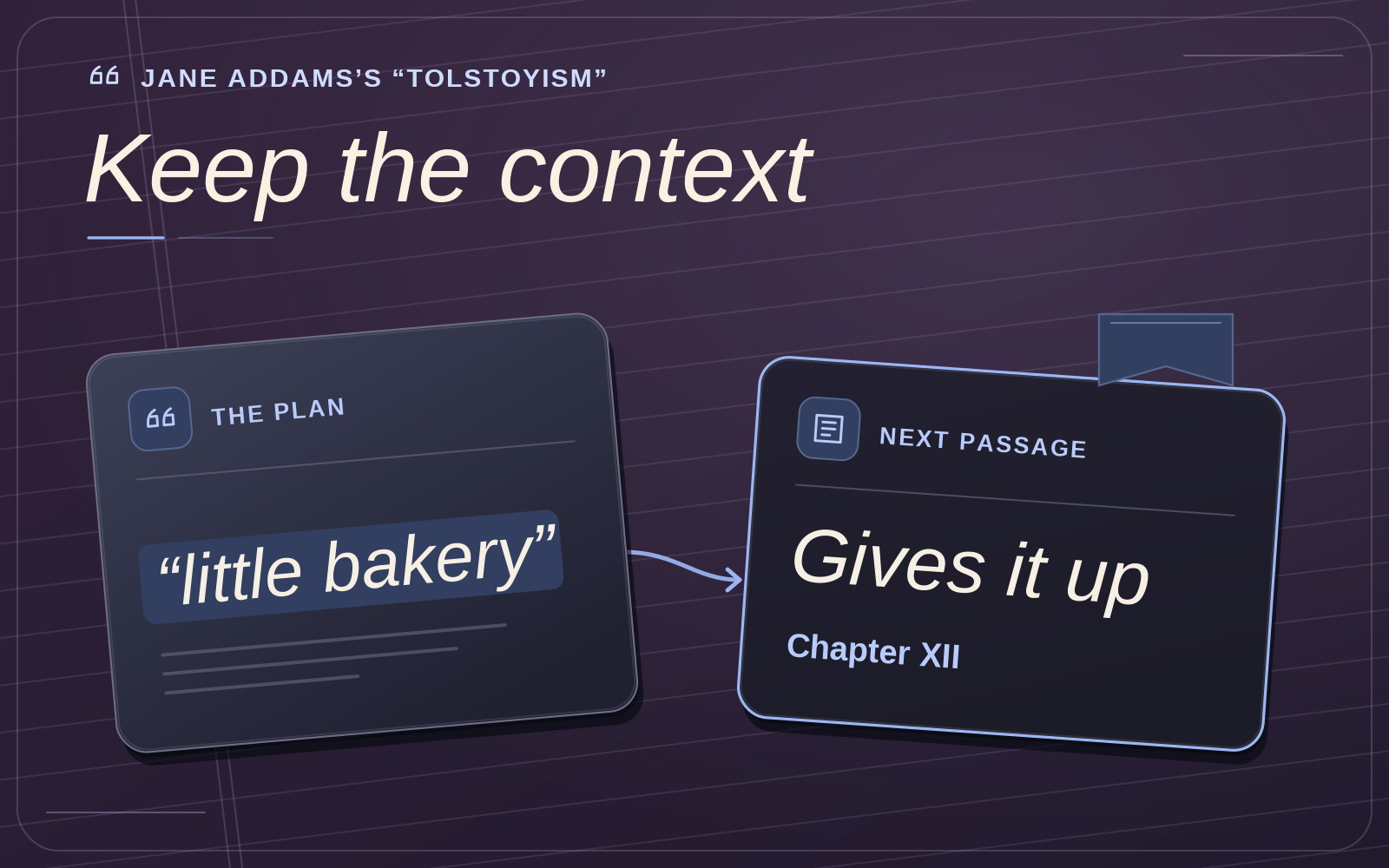
In Twenty Years at Hull-House, Jane Addams describes reading Tolstoy and deciding to spend at least two hours every morning in the bakery when she returned to Chicago. She recounts holding onto that plan on the way home and giving it up when she arrived. Save the scheme on its own and you can mistake the proposal for a report of what she did. Jane Addams, Twenty Years at Hull-House, ch. XII (opens in a new tab)
| Keep | What it records |
|---|---|
| Words | Select the clause about what she planned to do on returning to Hull-House. |
| Source | Addams, Twenty Years at Hull-House, ch. XII, “Tolstoyism”. Search within the chapter for “little bakery”. |
| Context | She is describing a plan inspired by her reading. The sentences that follow record her change of mind. |
| My reason | I want to discuss what happens when a plan made away from the work meets the work itself. |
Before taking the quote into a discussion, reopen the next passage as well as the sentence you saved. Write your interpretation as your own. The words can stay exact while the reason you kept them changes.
Questions readers ask
How much context should I copy?
Often a sentence about what happens around the line and a good source marker will do. Keep more when you need the exact argument.
What if I can only save one field?
Put the page or chapter after the words. Add a separate line starting “I saved this because…” when you next open the note.
Should I keep my paraphrase as well?
Yes, when your interpretation is the part you want to carry forward. Make it clear which words are yours.
Sources
Studies and reviews say what was measured. Books and guides are where an example or a method comes from. Videos describe one reader's practice: useful, but not evidence.
Guide
Readwise. Highlights, Tags, and Notes. Readwise Reader documentation.
Product documentation on adding a note or a tag to a highlight. Read 21 November 2026.
Read the guide (opens in a new tab)Book
Jane Addams. Twenty Years at Hull-House, chapter XII, “Tolstoyism”. University of Virginia American Studies (archived copy).
The chapter passage used for the example. Read 21 November 2026.
See the book (opens in a new tab)
Read this with your AI
Opens a new chat with the address of this article and a question ready to send.