What should you ask before agreeing with a book?
Write the claim, the author’s strongest reason and what could make that reason fall short before you decide whether you agree with a book.
In short
Before you agree with a book, write down the claim, the strongest reason and one thing that could make the reason fall short.
- You put a tick in the margin because the conclusion sounds right.
- Before you turn the page, can you say what the author gave you as a reason?
On this page
What should you check before you agree?
Hold off on a verdict until you can give an account the author would recognise. In chapter 5 of How to Read a Book, Mortimer J. Adler and Charles Van Doren distinguish grasping what an author is saying from deciding how far it is true. Try the distinction on one page before you give the whole book a verdict. See pp. 46 to 48. Publisher’s edition (opens in a new tab).
An immediate verdict can hide which reason you accepted. Robin Waldun starts closer to the page. He looks for the propositions the chapter argues for, then uses his marks to compose a chapter account. That gives you a place to begin. Pick one proposition and find the stretch of text that actually gives the reason. Waldun, 02:15 (opens in a new tab) · Waldun, 04:19 (opens in a new tab).
How does this work with Wollstonecraft?
In chapter II of A Vindication of the Rights of Woman, Mary Wollstonecraft argues that an upbringing aimed at obedience and pleasing men helps produce behaviours that are then treated as natural. Begin with a question the argument makes possible. What would you conclude about someone’s abilities if you knew they had been offered a different kind of education? Wollstonecraft, 1792, ch. II (opens in a new tab).
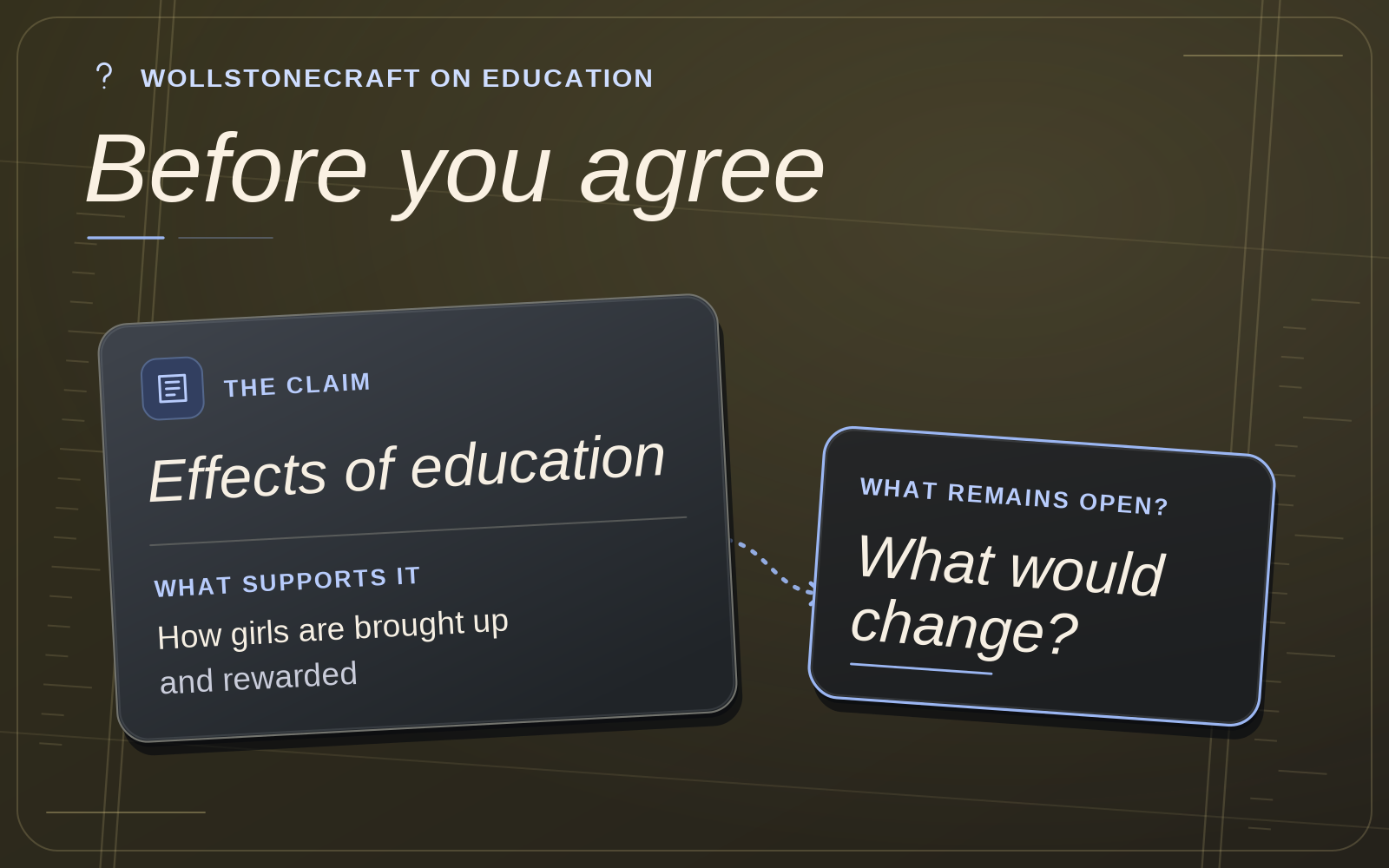
- State the narrower claim. The effects of an education can be mistaken for the limits of the people who received it.
- Say what supports it in the chapter. Wollstonecraft connects the traits she criticises to the way girls are brought up and rewarded. Mark the part that makes the connection rather than a line that only names a trait.
- Name what remains open. The mechanism gives a reason to question what the observations establish. It leaves a further question about what would change under different conditions.
- Choose what to read next. Look for a passage that connects a particular practice to a particular result. Keep a separate note on what would count as evidence today.
You can finish with a qualified view. The argument raises a strong objection to a conclusion about ability. You may still want evidence about the size of the effect of any particular educational change.
What if the evidence supports two explanations?
If the same evidence fits two explanations, write both down. Then name one thing you could learn that would help you decide between them. A precise question is a place to pick the book back up.
The next time you mark a conclusion, make room in the margin for its reason. If you run out of room, keep the page number and finish the thought when you stop reading.
Questions readers ask
Should I ask my question before I read?
Start with a question you have and revise it if the book turns out to be making a different claim.
What if the book has no obvious argument?
Pick one paragraph that asks you to accept a conclusion. See how far your method works there before trying it across the book.
What should I record?
Keep the claim, reason and location. Add which part you still want to check.
Sources
Studies and reviews say what was measured. Books and guides are where an example or a method comes from. Videos describe one reader's practice: useful, but not evidence.
Book
Mortimer J. Adler and Charles Van Doren (1972). How to Read a Book, revised edition, chapter 5. Touchstone.
Chapter 5 passages on printed pp. 46 to 48. Pages checked 21 November 2026.
See the book (opens in a new tab)Book
Mary Wollstonecraft (1792). A Vindication of the Rights of Woman, chapter II. Wikisource.
The chapter passage used for the example. Read 21 November 2026.
See the book (opens in a new tab)Video
Robin Waldun (2022). How To Get The Most Out of A Book: Analytical Reading 101. YouTube.
Find the propositions a chapter argues for, then write a chapter account from the marks. Captions at 02:15 and 04:19 read 21 November 2026. A practice, not a study.
Watch the part (opens in a new tab)
Read this with your AI
Opens a new chat with the address of this article and a question ready to send.