Can one flashcard help you practise an idea with several moving parts?
Write one review prompt that asks for a link in a book’s reasoning, with a few checks to compare your answer against.
In short
Give the prompt one job.
- Ask for the link between two parts of a book idea and write down what a good answer should include.
- Try the question with the book closed, then check what you left out.
- Use a different example when you want to see where the reasoning carries over.
On this page
What makes a prompt too small or too large?
A prompt is too small for an explanation when it reveals the relationship and asks for a missing word. It is too large when it asks you to reproduce the whole chapter. Choose one step of the reasoning that is worth being able to reconstruct. “How did the author get from this observation to that inference?” is a form you can adapt to a specific passage.
Keep two or three checks on the reverse side. A useful check might name the observation, the mechanism that could explain it and a condition that would change the inference. These are cues for checking the answer. Your attempt can use different words.
How do you make a prompt from an argument in a book?
In On the Connexion of the Physical Sciences, Mary Somerville recounts how discrepancies in Uranus’s motion were attributed to the pull of an unseen planet. She discusses the reasoning in the account of Neptune’s discovery. Mary Somerville, On the Connexion of the Physical Sciences (opens in a new tab)
| Prompt | What it asks you to do |
|---|---|
| Which planet was predicted from discrepancies in the motion of Uranus? | Name Neptune. |
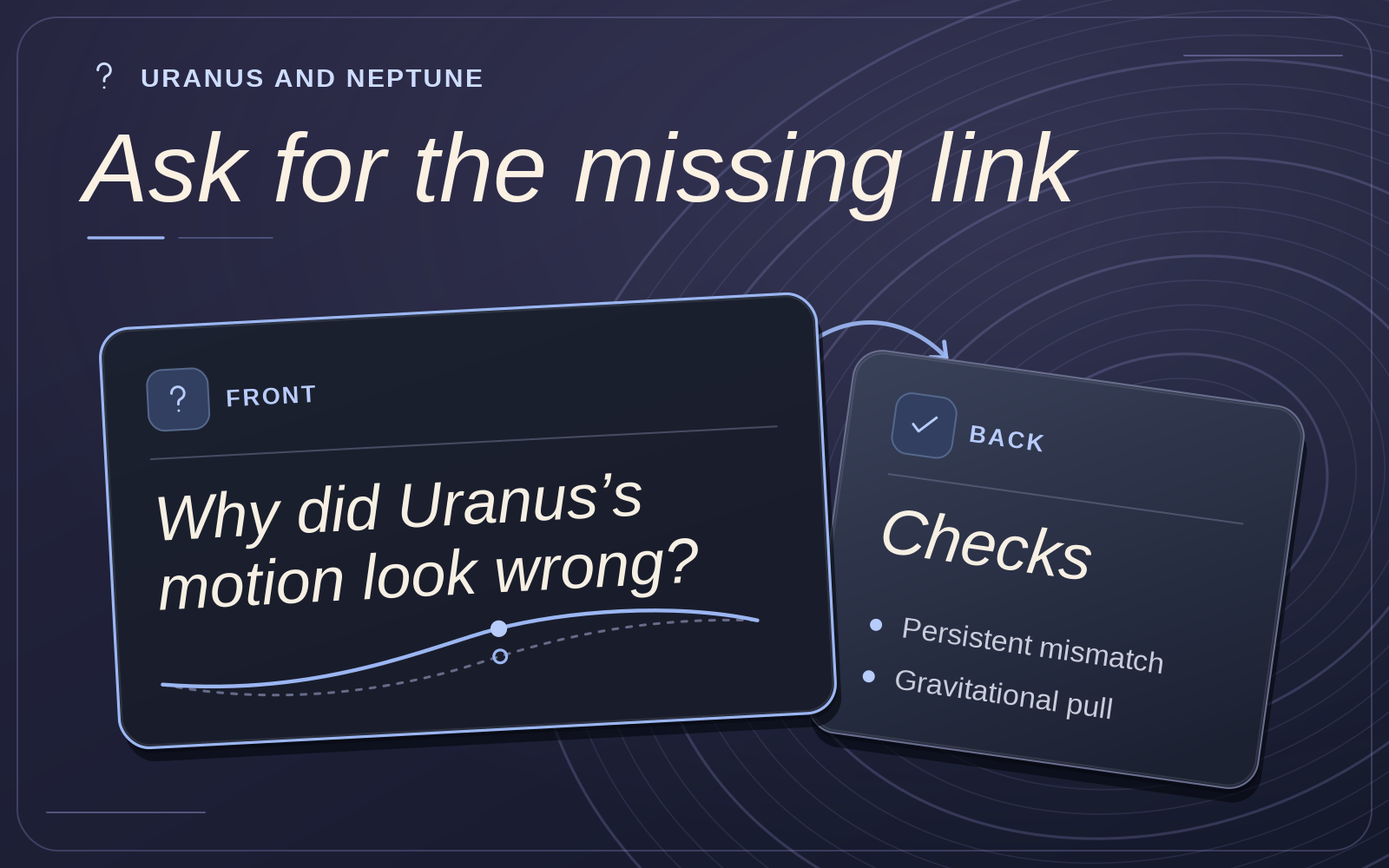
| Why could differences between the predicted and observed motion of Uranus point to a planet no one had seen? | Explain how the gravitational influence of an additional body might account for a persistent discrepancy. |
| What else should you check before treating such a discrepancy as evidence of a new body? | Consider whether observations or the existing account are incomplete. Return to the book to see which alternatives it discusses. |
Try the middle prompt first. A short answer might mention the mismatch between prediction and observation and the possible gravitational pull of an additional body. Reopen the passage to see whether you described a possible explanation or jumped straight to a discovery. The third prompt checks a limit you could miss while remembering the story.
What might change when you ask a new question?
A new question can reveal whether you can use the relationship in your own example. For instance, suppose a planet’s predicted path looks wrong because a telescope’s calibration is off. What would you want to check before adding a new object to your explanation? That is a fictional case for practising the distinction, with its details kept separate from the book.
Where should you put the prompt?
Put it where you can see the question before the answer. A folded page works. The basic card formats in Anki and RemNote let you put a question on one side and your checks on the other. Choose a tool after deciding what you want the prompt to ask. Anki manual (opens in a new tab) · RemNote flashcard basics (opens in a new tab)
Make one prompt before making a deck. If a second attempt still produces a list of names, ask which link you wanted to be able to explain.
Questions readers ask
When is a short factual prompt useful?
Use one when you need a definition, name or other precise detail. Add a separate explanation question when you want to remember how the details fit.
What if my answer matches the idea in different words?
Check the reasoning and its conditions against the source. Keep the wording that lets you explain it clearly.
What if two explanations belong in the answer?
Choose the one the text is trying to show here. Give the other its own question if you have a reason to revisit it.
Sources
Studies and reviews say what was measured. Books and guides are where an example or a method comes from. Videos describe one reader's practice: useful, but not evidence.
Study
A. C. Butler (2010). Repeated testing produces superior transfer of learning relative to repeated studying. Journal of Experimental Psychology: Learning, Memory, and Cognition.
Four experiments with prose passages and a final test a week later, including new inference questions. Abstract read 21 November 2026.
Read the study (opens in a new tab)Book
Mary Somerville (1858). On the Connexion of the Physical Sciences, ninth edition, section VIII. Project Gutenberg.
The passage on Uranus and Neptune used for the example, pp. 60 to 62. Read 21 November 2026 in the same Gutenberg ebook on an official Gutenberg mirror.
See the book (opens in a new tab)Guide
Anki manual. Getting Started. Anki Docs.
Documentation of the basic card with a front and a back. Read 21 November 2026.
Read the guide (opens in a new tab)Guide
Soren Bjornstad (2026). Flashcard Basics. RemNote Help Center.
Documentation of the basic flashcard with a front and a back side. Read 21 November 2026.
Read the guide (opens in a new tab)
Read this with your AI
Opens a new chat with the address of this article and a question ready to send.