How far to read before taking a note without losing your place
Decide when to stop and write while you read, using a quick mark until the next passage shows what a line is doing.
In short
Give a line a small mark if the next paragraph could change what it means.
- Write the note when you can say what happened, what the author showed or where you found the detail you needed.
- A section boundary is a useful place to check whether you’re there.
On this page
Why can writing at every good line get in the way?
The next paragraph can change the job of a good line. You might be looking at the objection an author is about to answer, or at the first step of a story whose outcome changes what you make of it. A quick pointer lets you find the line later without having to decide what it means right now.
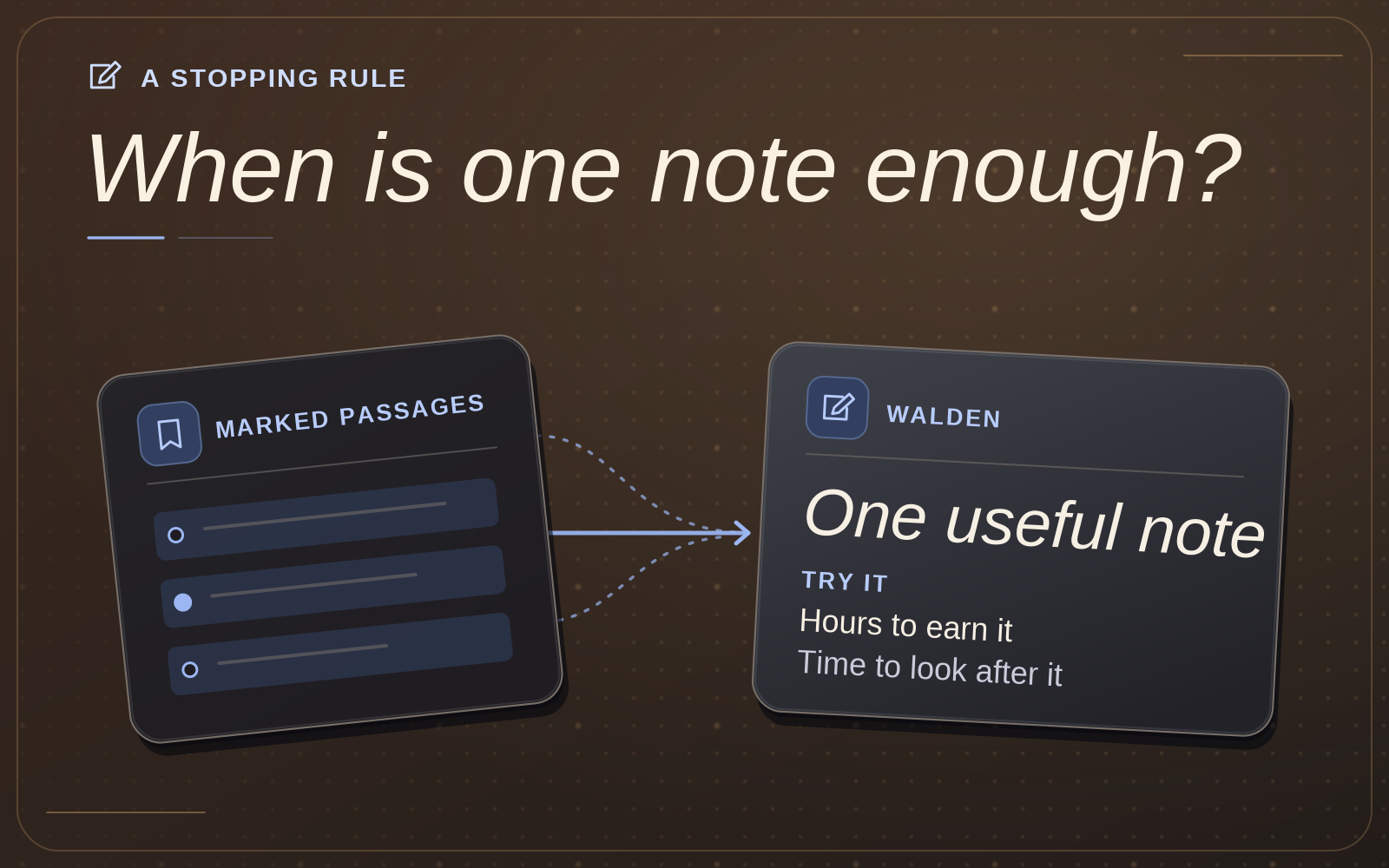
The opposite choice has a cost too. If an author’s next move depends on a definition you can’t explain, waiting until the end can leave the rest of the section hard to follow. Take one short note that will let you read the next sentence. You can decide how much of it to keep when you reach a break.
Which stopping point fits what you’re reading?
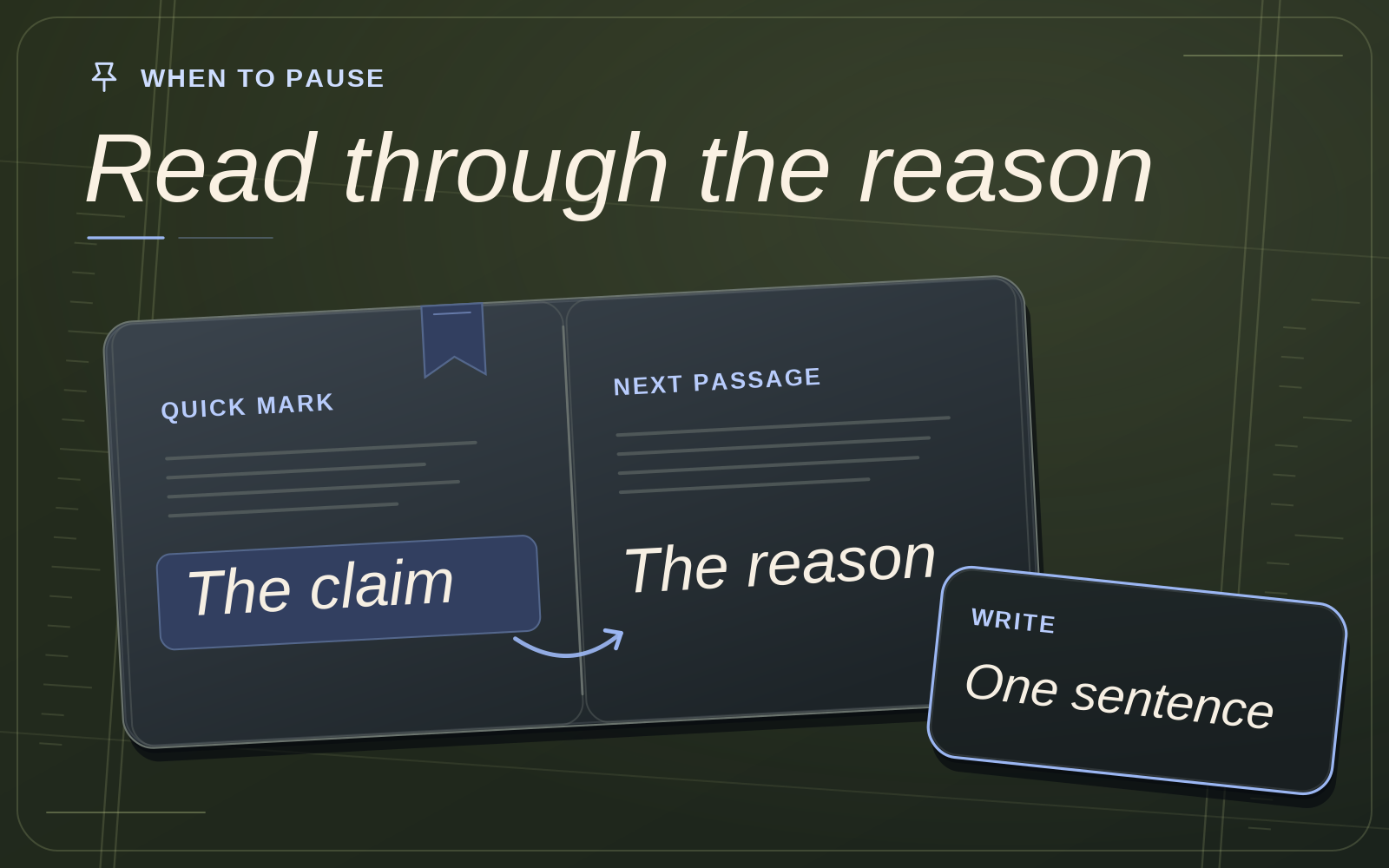
Stop at the smallest useful unit for the note you need. If you’re following an argument, read through the claim and the reason that goes with it. When you’re following a true story, finish the scene or see what changed before compressing it. If you opened a reference book to check a single detail, stop after you have the answer and the context that makes it true.
| What you’re doing | When to pause | What to keep |
|---|---|---|
| Follow an argument | A claim and its reason are both on the page. | One sentence connecting them. |
| Stay with a true story | An event reaches its immediate outcome or the scene changes. | What changed, and what detail you might want to find again. |
| Look up a detail | You have the answer and any qualification needed to use it. | The answer in context and its location. |
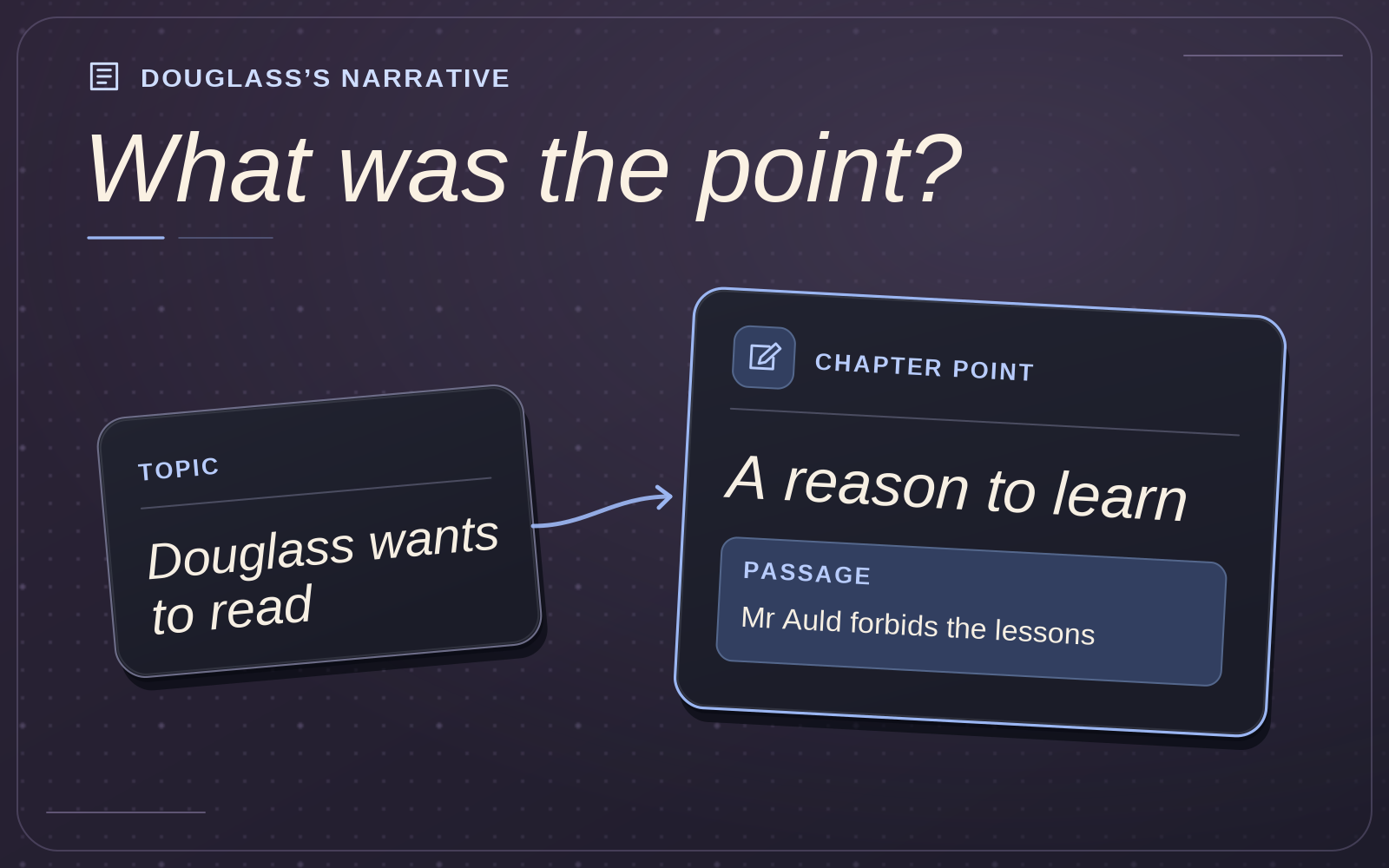
Cornell’s textbook-reading guide describes reading one headed section and looking away to recite its answer. That boundary is a teaching convention you can borrow for a nonfiction book. Harvard Library’s guide gives a different job to a margin mark. Use it to catch a question while you’re still reading. Cornell Learning Strategies Center (opens in a new tab) · Harvard Library, Interrogating Texts (opens in a new tab).
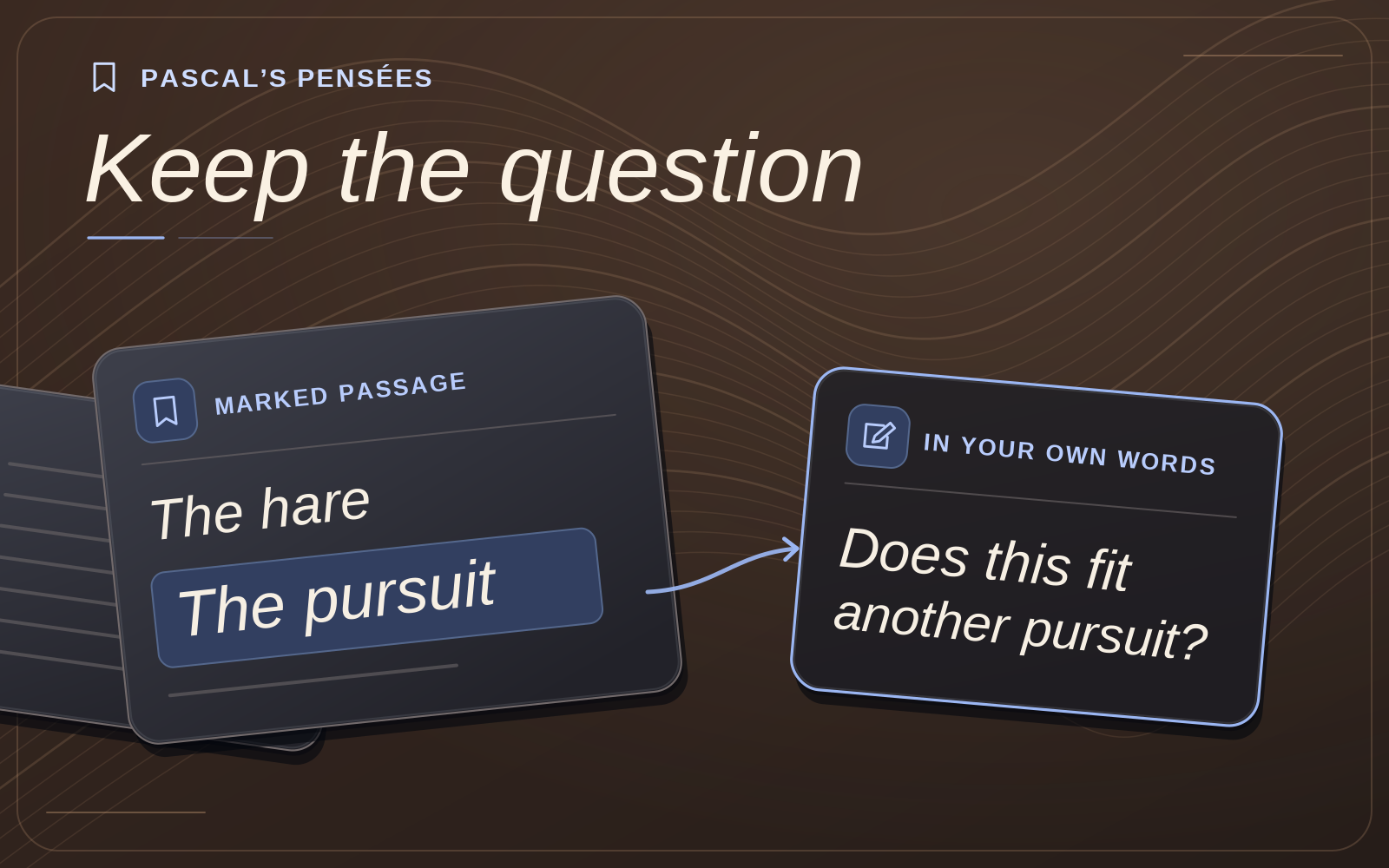
Cal Newport demonstrates giving a meaningful page a quick mark and pointing to the specific passage. Jeffrey Kaplan writes his way through a difficult argument, tracking what each paragraph adds. Choose the lighter action when you only need the page again. Write as you go when the next passage depends on keeping the reasoning straight. Newport, 07:37 (opens in a new tab) · Kaplan, 04:49 (opens in a new tab).
Where would you stop in Dana’s first night at sea?
Read to see what changes before deciding what the scene is about. In chapter II of Two Years Before the Mast, Richard Henry Dana Jr. describes being seasick below deck before he is ordered up to reef the topsails in the dark. You could put a small mark where he describes the confusion below. Read on through the order and the return below deck. Now write one sentence about the first night. Even while he was still learning how to stand and move at sea, the work could require him to go aloft. The opening discomfort and the order belong in the same note if that’s what you want to keep. Dana, Two Years Before the Mast, ch. II (opens in a new tab).
If you were checking what Dana means by reefing, the note would do a different job. Mark the term and find a definition that lets you follow the action. You can carry on once the line makes sense. You have enough for a source pointer without writing an account of the whole scene.
What if you have to stop in the middle?
Leave one line to yourself when you stop mid-section. Write a page number and the question you were in the middle of following. At your next sitting, start by seeing whether the following paragraph answers it. A note that tells you where to resume has done its job.
Questions readers ask
Do I have to finish the whole chapter first?
No. A self-contained section or scene is enough when it gives you what you wanted from the reading.
What if I’m reading for pleasure?
Keep going if you want to. Leave a mark only for a place you can imagine wanting to find again.
What if I can’t explain why I marked a line?
Read the surrounding sentences and see what job the line does. If you still don’t have a reason to keep it, you can leave the mark alone.
Sources
Studies and reviews say what was measured. Books and guides are where an example or a method comes from. Videos describe one reader's practice: useful, but not evidence.
Book
Richard Henry Dana Jr. (1840). Two Years Before the Mast, chapter II. University of Denver transcription.
The chapter passage used for the example. Read 21 November 2026.
See the book (opens in a new tab)Guide
Cornell Learning Strategies Center. Textbook Reading Systems. Cornell University.
A university teaching guide to reading textbooks, including reading one headed section and reciting its answer with the book closed. Full guide read 21 November 2026.
Read the guide (opens in a new tab)Guide
Susan Gilroy (2026). Interrogating Texts: Six Reading Habits to Develop in Your First Year at Harvard. Harvard Library.
A university library guide to annotating while reading, including writing questions in the margin. Page last updated June 2026, read 21 November 2026.
Read the guide (opens in a new tab)Video
Cal Newport (2024). A Productivity System To Remember Everything You Learn & Get Ahead In Life. YouTube.
Practitioner demonstration of marking a page and the passage on it. Captions at 07:37 read 21 November 2026. A practice, not a study.
Watch the part (opens in a new tab)Video
Jeffrey Kaplan (2021). Lecture #9: How to Read so that you Retain Information. YouTube.
A philosophy teacher writes a running line in the margin as an argument builds. Captions at 04:49 read 21 November 2026. A practice, not a study.
Watch the part (opens in a new tab)
Read this with your AI
Opens a new chat with the address of this article and a question ready to send.